More Sorting Options in Scrap and Aluminum Recycling
In situations, for example, where recovered, recycled aluminum is being used to produce new products, manufacturers need their secondary raw materials to display consistently high levels of purity.
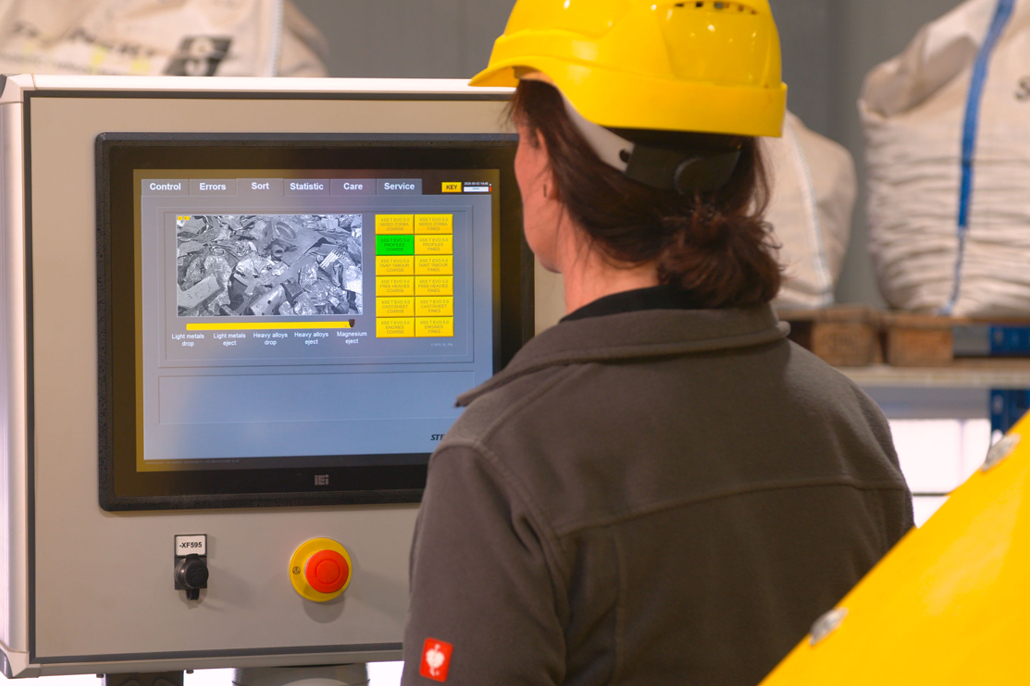
According to the German machine producer Steinert, this is possible by employing sophisticated sorting technology, for example, the new STEINERT XSS T EVO 5.0 machines (XSS T = x-ray sorting system with transmission). Dry density sorting using x-ray transmission is a proven method utilized by hundreds of metal recycling firms worldwide. The sorting machine is used to separate free heavy metals, aluminum compounds, free magnesium as well as wrought and cast aluminum parts. Now, the company’s development work would ensure specific benefits for the sorting process.

Photo: Steinert
Thanks to the new software Multilayer Data Evaluation (MDE), “the sorting machine is able to use even more distinguishing criteria for detection thanks to high-resolution object recognition and by undertaking classification in parallel,” the manufacturer explained. “Complex sorting tasks, such as magnesium detection are solved easily. Automatic x-ray monitoring and calibration (AXM) of the x-ray sensors help achieve consistently high detection and sorting quality.” The hardware has also been improved, as Steinert emphasized. The high-resolution valve pitch of 6.25 millimeters (mm) would enable even more efficient sorting of fine material down to 5 mm. “The x-ray scan area is cleaned automatically in the new generation of machines. This vastly reduces the amount of manual cleaning needed and maintains a consistently high level of detection quality.” The 4-year warranty for the x-ray source and sensors would provide operational reliability and keep operating costs low. Other features include continuing software and hardware updates.
How does detection with x-ray transmission work?
The extent of absorption of x-rays depends on the material density and on the thickness or the radiated path of an object. The larger the atomic mass and the thicker a material part, the more radiation will be absorbed. The absorption in the material to be sorted is measured at two different energy levels to compensate for the influence of the object thickness.
The “dual-energy procedure” uses software to determine the material-specific absorption and thus the procedure conclude the density of the material. Moreover, the radiation passing through the objects enables both the conclusion of an average density for an object and the identification of inclusions in rocks or clumps of material.
Downloadable e-book for guidance on sorting options
Photo: Steinert
A so-called solution guide can be downloaded as an e-book to provide an initial overview of the opportunities provided for sorting aluminum scrap and other materials. Although aluminum scrap comes from different sources like profiles and plates, incineration bottom ash, shredder systems or Dense Media Separation (DMS), the rough stages of the sorting process are similar: recovering non-ferrous metals and upgrading the recovered metals, in other words, producing pure metal types. The e-book provides insight into both the heart of the systems – the STEINERT XSS T EVO 5.0 – as well as the upstream magnet technology and downstream fluorescence technology; of benefit to operators of aluminum shredders, secondary smelters or processors of waste incinerator ash. The downstream fluorescence technology produces pure heavy metal fractions such as copper, brass and zinc.
www.steinertglobal.com/metal-recycling/aluminium-recycling/#c32158
The main advantage of X-ray transmission is that its transmissive detection makes the system insensitive to surface soiling and enables the detection of inclusions. That is the case in mining, for example, with pyrite accumulations in chunks of ore or in recycling with heavy metal inclusions in pieces of aluminum. Moreover, it is possible to mask materials of low density. Thus, it is possible to significantly increase the throughput in applications and remove impurities from a closed supply flow (e.g. metals from waste wood).
The sorting process in detail
A vibration conveyor is used to carry the sortable material on an acceleration belt, which breaks the supply flow down in the supply direction, thus achieving material separation. The feed material is transported through the scanner area in a position on the conveyor belt. Thereby the x-ray source is positioned below the conveyor belt and radiates a narrow area of it. Detectors in the beam above the conveyor belt measure the radiation‘s proportion not absorbed by the material. The variation between initial and measured radiation can be used to reveal differences in density between or within individual objects, Steinert assured. Each object was classified according to application-related criteria. Should the decision to sort be positive, the relevant object is deflected from the discharge parabola using a short, targeted blast of compressed air, transported by a separating splitter and thus separated from the remainder of the material flow.
Semi-mobile sorting machine
A semi-mobile variant is installed in a 40‘ container. A further 40’ container contains the operating room with the controller. “The focus of the semi-mobile STEINERT XSS T EVO 5.0 is on mineral processing, although it can also be used in other sectors,” the manufacturer informed.
(Published in GLOBAL RECYCLING Magazine 3/2021, Page 48, Photo: Steinert)