Greece: Firm Plans to Improve the Situation
The country still sends nearly 80 percent of its waste to landfills, despite the investment in treatment and recycling infrastructure.
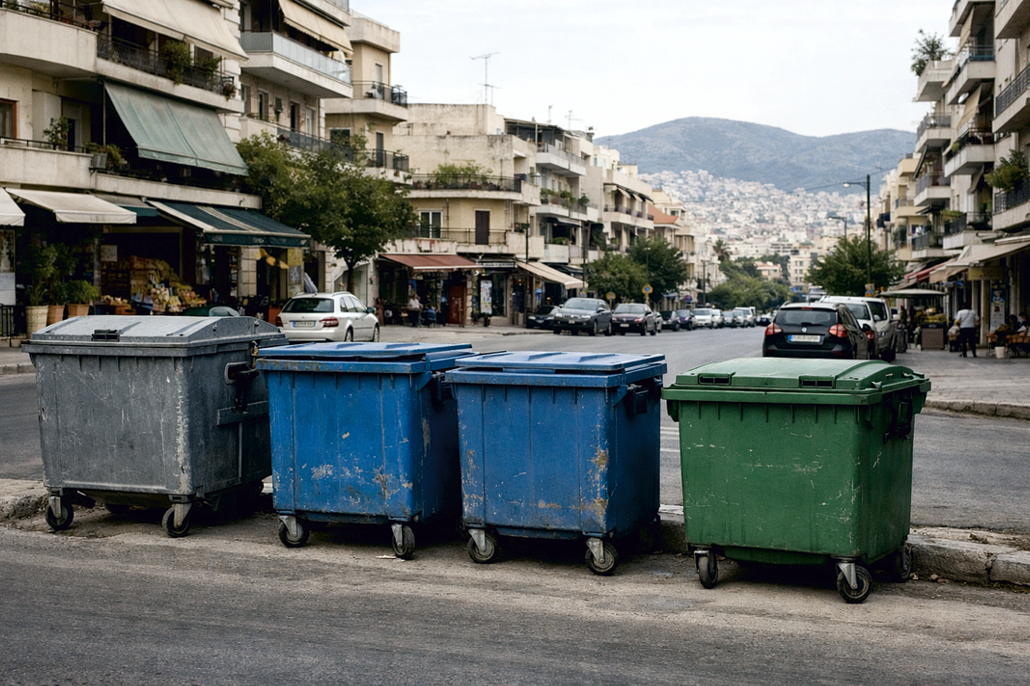
In October 2025, pan-European news network euronews.com reported that Greece still faces a waste problem. The situation would be particularly critical in Athens and the wider area of the Greek capital. “The streets of Greek cities are full of bins collecting all kinds of materials: plastic and aluminum packaging, paper, food scraps, footwear, and clothing. In many different retail stores, there are special bins that collect batteries and electrical appliances for recycling. And yet, Greece continues to bury around 79 percent of its waste,” euronews.com wrote, referring to information from the Greek Association of Recycling and Energy Recovery Industries and Enterprises (SEPAN).
According to Lena Belsi, President of SEPAN, the country’s recycling rates reach barely 17 percent, a level that is one of the lowest in the European Union. There are two main reasons, why the Greeks do not recycle more:
- Landfilling is still the cheapest solution. The landfill fee remained at 35 Euro per ton in Greece, while in other EU countries the cost per ton “was the main disincentive that worked and increased recycling rates”.
- The second reason has to do with the mentality of many Greeks. “Citizens take their rubbish outside their house and then think it disappears,” Lena Belsi was cited. Then they would forget about it. But the waste would not disappear. “Landfilling garbage does great harm to the environment.”
Decreasing waste quantities
Over time, Greece was able to reduce the amount of waste. The highest volume was stated in 2012, when the country with a population of about ten million citizens generated more than 71 million tons of non-hazardous waste, according to figures published by the European Environment Agency (EEA). At that time, no recycling occurred. Since then, the situation improved a lot. But there is a lack of reliable data.
In December 2024, the Hellenic Statistical Authority (ELSTAT) announced the provisional data on the generation and treatment of waste for 2022. According to these figures collected from administrative sources, the country’s waste generation amounted to 29.826 million tons and increased by 5.2 percent compared to 2020 (28.359 million tons). Looking at the main waste categories, “mining and other waste activities” accounted for 66.1 percent and “municipal solid waste” for 20.6 percent of total waste generated. Furthermore, “recyclable waste” had a share of 8.2 percent; “chemical and medical waste” was 4.0 percent, while “sludge” required the least amount of waste with 1.1 percent.
At the same time, waste treatment rose by 8.1 percent to 23.391 million tons compared to the same year (in 2020, waste treatment amounted to 21.648 million tons). Regarding waste treatment by category of waste, “mining and other waste activities” amounted to 15.660 million tons (or 67 percent). “Municipal waste” reached 4.540 million tons (or 19.4 percent). From the quantity in 2022, in total 713,986 tons went to “incineration”, 10.977 million tons to “recovery other than energy recovery”, and 11.699 million tons to “disposal”.
As reported by the publication “Greece in Numbers”, the volume of municipal waste reached 5.420 million tons in 2022; 937,000 were recycled and 4.386 million tons landfilled. In 2023, the situation improved a little bit regarding recycling. According to the same publication, 5.440 million tons of municipal waste were treated: 948,000 tons made their way into recycling; 4.389 million tons went to landfill, and 103,000 tons were treated in different ways.
In its latest country profile “Europe’s environment 2025,” the EEA stated: “Greece is accelerating its green transition, aiming to improve its environmental status, reduce its greenhouse gas (GHG) emissions and protect its ecosystems. The country is reducing its fossil fuel dependence, expanding the use of renewables, and promoting energy self-sufficiency, yet affordability and economic disruptions from lignite phase-out remain key concerns.” Regarding waste, the country is on track, as the waste generation trends in Greece highlight both progress and challenges in waste prevention and in decoupling waste production from economic growth.
As per EEA, municipal solid waste (MSW) generation per capita increased from 436 kilograms (kg) in 2004 to 519 kg in 2022. This was “a little above the European average of 515 kg, although total waste generation remains below the EU average”. Total waste generation had fallen between 2010 and 2018. “While the gross domestic product (GDP) dropped sharply between 2010 and 2013, waste generation decreased more gradually, with a significant drop from 2014 to 2016 during economic stabilization. After 2016, both GDP and waste generation began to rise again, suggesting a potential re-coupling of economic growth with waste production,” the agency reported. Trends would vary by waste type. “Industrial and construction waste declined with the economic downturn, while municipal waste remained high due to steady consumption patterns. Hazardous and electronic waste present ongoing concerns due to their environmental impact and management challenges.”
However, the situation in Greece, while improving, cannot yet be deemed satisfactory despite the progress in waste reduction. “To confirm trends in decoupling waste from economic growth, a detailed time series is crucial,” the European Environment Agency wrote. “Current data suggest that Greece is not meeting EU waste prevention and circular economy targets. The lack of correlation between population dynamics and waste generation further emphasizes the role of economic and consumption behaviors. Addressing these issues requires comprehensive policy measures, targeted interventions for different waste streams, and enhanced monitoring to meet European waste reduction goals.”
Policies
As a matter of course, Greece has implemented legal requirements to encourage waste prevention measures and to increase recycling. “The legislative framework considering waste is very wide and includes other related laws, such as the Joint Ministerial Decision 114218/1997, which sets specifications for specific waste treatment operations,” the EEA gave account in its “Waste Management Country Profile”, published in March 2025. “The National Waste Management Plan 2020-2030 was published in 2020. (ETC/CE, 2022) Additionally, the new National Circular Economy Action Plan was published in 2022, covering the period until 2025. This Plan has as key objectives, among others, to reduce waste, to increase high-quality recycling and reuse, and to promote the use of secondary materials.”
Regarding waste, the National Waste Prevention Program (NWPP) of Greece were a stand-alone strategic document and addresses the years 2021 to 2030. Objectives, among others, are:
- “promoting circular consumption, raising awareness, and providing tools for citizens to transition from a linear to a circular model of behavior and consumption,
- setting waste reduction targets for specific streams,
- encouraging the perception of waste as a resource within the broader context of the circular economy,
- strengthening waste prevention efforts through an integrated and systematic public awareness campaign and
- developing and promoting a new industrial strategy to transform the production processes towards circularity.”
According to the information, the prioritized waste streams include food waste, paper waste, packaging waste (specifying different types of plastic), waste electrical and electronic equipment, textile waste, bulky waste, industrial waste, and waste generated from excavation, construction, and demolition activities.
Examples for initiatives
In Greece, the Hellenic Recycling Agency (HRA/ΕOAN) has an institutional role in recycling, as it ensures the implementation of waste prevention policies and the alternative management of product waste, for which prevention measures and/or alternative management programs are being implemented. The organization also proposes such measures and programs to the Minister for the Environment and Energy.
An example of an alternative waste management program is the National Collective Alternative Management and Recycling System of Packaging “Rewarding Recycling”. It is a non-profit organization, approved by the Ministry of Environment and Energy, whose mission is to organize and promote the recycling of packaging throughout the country.
The Epirus Waste Treatment Plant produces energy from municipal waste. The facility, constructed by Terna Energy, was launched in March 2019. The plant’s maximum annual capacity is 105,000 tons. Its operation recovers a total of 17,000 tons of recyclable materials per year while producing 10,800 MWh/year of energy, capable of meeting the needs of 3,000 families. At the same time, 12,000 tons of CO2 are saved per year.
JASPERS (Joint Assistance to Support Projects in European Regions), a partnership funded by the European Commission and the European Investment Bank (EIB), reported that the Peloponnese region started to build an integrated waste management system. This system would include three integrated waste management centers in Arkadia, Messinia, and Lakonia, and two transfer stations in Argolida and Corinthia. Together, they are to form the backbone of a new regional plan for the separate collection of waste streams. “The system is designed to treat, recover, and recycle waste efficiently, produce compost for agricultural use, and generate energy from biogas,” JASPERS gave account. The investment totals more than 125 million Euro and is implemented under a public-private partnership. With expert advice by the EIB under the JASPERS initiative, the project secured a 65 million Euro grant from the EU cohesion fund in April 2025. The remaining financing comes from private investors and national public sources.
In December 2024, the energy dedicated portal ceenergynews.com reported that Greece would build a modern waste recycling plant in Patras (Peloponnese). According to the information, the facility is to handle three waste streams and maintain minimal residual waste, enabling the region to meet the landfill target of less than ten percent by 2027, when the plant is expected to become operational. “The construction of the waste treatment plant in Patras, which will meet the needs of the Achaia Prefecture, marks a significant milestone in the government’s reform agenda,” the Minister of Environment and Energy, Thodoros Skylakakis, was quoted. As per the Secretary General for Waste Management Coordination, Manolis Grafakos, the new plant in Floka, Achaia, is among the country’s largest environmental projects. It would support the national efforts to transition to sustainable waste management practices by reducing landfill use and promoting recycling and reuse. “To date, 12 such units are operational across Greece, with an additional 23 under construction.”
Investment opportunities
Enterprise Greece (enterprisegreece.gov.gr/en/) is the official investment and trade promotion agency of the Greek State, operating under the auspices of the Ministry of Foreign Affairs. It is the gateway to the opportunities Greece offers. The agency’s mission:
- Providing foreign investors “with a one-stop shop for information, consulting, and assistance through every phase of their investment project, and
- promoting Greek products and services in international markets.
The state agency puts emphasis on sustainability. It aligns with the Greek government’s Green Deal and just transition strategies by prioritizing environmental protection, biodiversity conservation, and social value creation. “Committed to a sustainable approach, Enterprise Greece integrates ESG (Environmental, Social, and Governance) principles into all its activities,” one can read on the homepage. “This dedication is evident in the criteria applied to evaluate new investment projects, business plans, and export initiatives.”
It goes without saying that this also applies to renewable energy sources and waste management. “Since 2007, Enterprise Greece has prioritized these sectors, recognizing their essential role in a sustainable and resilient economy,” the agency emphasizes.
(Published in GLOBAL RECYCLING Magazine 1/2026, Page 24, Photo: MSV, AI-generated)