How Briquetting Helps Turn Machining Chips into a Higher-Value Recycling Stream
In metalworking, chips are generated in large volumes every day during turning, milling and sawing. Yet their loose form creates multiple disadvantages: they take up space, complicate handling and transport, often retain cooling lubricants, and can lead to material losses in downstream recycling. For recyclers, foundries and machining companies alike, the question is no longer whether chips contain value – but how much of that value can actually be recovered.
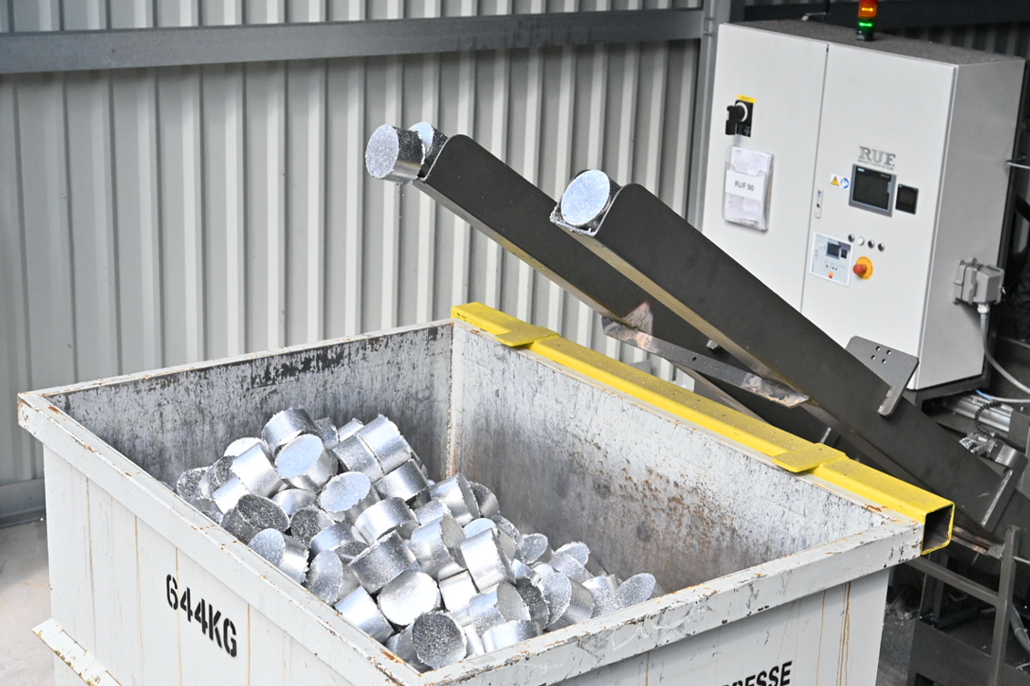
That is where briquetting is gaining relevance. By compressing loose chips into dense briquettes, metal processors can create a more homogeneous, easier-to-handle secondary raw material while also improving logistics and recovering residual coolants. In many cases, the biggest benefit appears further downstream: during remelting.
A practical example comes from Hammerer Aluminium Industries (HAI). In its aluminium operations, the company uses RUF briquetting presses to close the material loop more efficiently. According to HAI, remelting loose aluminium chips results in a material yield of around 85 percent. With briquetted chips, however, yield rises to 92 to 93 percent – an improvement of roughly eight percentage points. HAI also reports that briquettes sink immediately in the melt, while oxidation during storage before remelting is kept to a minimum.
The process brings further advantages. Because cooling lubricants are largely removed during pressing, the briquettes are cleaner to transport and cause far less contamination from dripping fluids. At the same time, densification drastically reduces the volume of the material, lowering storage and logistics costs and creating a defined scrap quality for internal recycling or external sale. For companies looking to strengthen circularity in machining and metal recycling, this makes briquetting more than a volume-reduction step. It becomes a way to improve metal recovery, reduce process losses and turn chips into a more valuable feedstock for the furnace.
RUF Maschinenbau, based in Germany, supplies hydraulic briquetting systems for materials including aluminium, steel, cast iron, copper, magnesium and titanium. The company says its presses can also recover expensive cooling lubricants and support throughputs from about 30 to 5,000 kg/h, depending on the application.
Visitors interested in exploring briquetting technology can meet RUF at IFAT 2026, Hall B5, Stand 232, where the company will present solutions for metal chips and other recyclable production residues.
brikettieren.de/brikettpressen/spaenepresse-metall
(Published in GLOBAL RECYCLING Magazine 1/2026, Page 39 -Advertorial-, Photo: RUF)