A Slag Called SiGS Can Be Turned into a Building Material
According to SINTEF – “Norwegian Stiftelsen for industriell og teknisk forskning” – greenhouse gas emissions from concrete production can be reduced, if a part of the cement is replaced by SiGS (Silica Green Stone), a slag waste resulting from the manufacture of silciomanganese, which is a key component in steel production.
“In our tests, we’ve replaced up to 40 percent of the cement normally used in concrete”, SINTEF cited Per Anders Eidem, a researcher working on the project VALSiGS at the Norwegian science institute. By using finely powdered slag as a binder additive, significant reductions in the climate footprint of concrete have been achieved. As reported, the method has resulted in up to a 95 percent reduction of greenhouse gas emissions compared to the usage of traditional cement. Regarding global greenhouse gas emissions, eight percent are derived from concrete manufacture.
The SiGS slag is a by-product, traditionally used as an industrial fill, Per Anders Eidem underlined. “Adding such by-products to concrete is just one of a number of initiatives that the cement manufacturers are trying out in order to address their climate footprint. Another has been the use of flue ash derived from coal-fired power stations, but access to this material is now becoming more restricted, and it’s unlikely that much more will become available.” Slag from iron smelting is another by-product used in cement. “The SiGS slag that we’re studying now has some similar properties to that which we derive from the production of iron in blast furnaces”, he explained.
Cooperation and good results
In order to conduct tests on the SiGS slag, SINTEF and the multinational mining and metallurgy company Eramet have joined forces with concrete paving specialists Aaltvedt Betong and prefabricated slab manufacturers Block Berge Bygg.
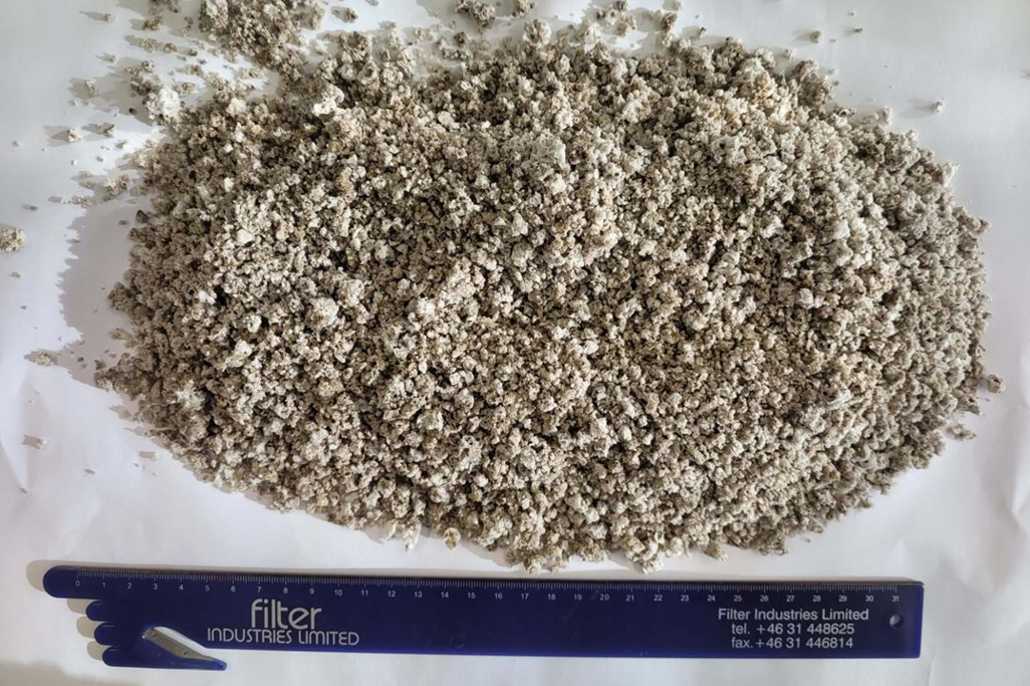
“We ground down the slag in order to find out how it would behave as a cement substitute. Eramet cooled down the SiGS and ground it down to the same particle size as the cement. Then they made both a dry concrete mixture, similar to that used to cast paving stones, and a wet mixture, such as that used in building constructions”, Eidem reported.
Strength measurements were performed after 28 days, the standard period for concrete strength tests. The results showed that the concrete increases in strength as it ages, far beyond the 28-day period. As reported by SINTEF, the researchers’ conclusion is that the ‘SiGS concrete’ is strong enough to be used for the same purposes as concrete containing pure cement without any slag additives. “Its early strength is lower, but after 28 days, this increases so that it becomes just as strong as so-called environmental cement – at least, in the case of the dry concrete mixture”, Eidem was cited.
The results were good, even with as much as 40 percent of the cement replaced by SiGS. However, in the next stage of the project, when the SiGS cement will be tested at a larger scale, it is likely that a smaller proportion of the SiGS slag will be incorporated into the mixtures than in the initial experiments.
SiGS and binding agents from other suppliers are now going to be tested as part of some pilot projects.
(Published in GLOBAL RECYCLING Magazine 3/2024, Page 35, Photo: SINTEF)