
Saudi Arabia Ventures into Sustainable Waste Management
The Kingdom of Saudi Arabia’s National Center for Waste Management (MWAN) aims to significantly reduce waste production, increase recycling rates, and divert 90 percent of its waste from landfills.
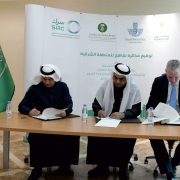
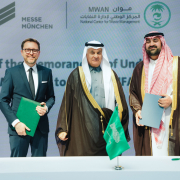
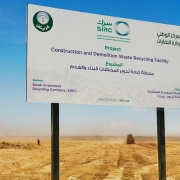
At the IFAT trade fair in Munich, the country informed about its strategies for the first time. As underlined by MWAN, it is clear that Saudi Arabia’s ambitious transformation and stated objectives for the waste management sector will offer investors lucrative opportunities and returns. “By 2040, over 840 treatment and recovery facilities will be built to achieve the national objectives and targets for the waste sector. These will include waste-to-energy, recycling and recovery, composting in addition to construction and demolition recycling facilities and other key infrastructure,” the information said. “This investment will help the kingdom achieve its recycling targets of 79 percent (up from the current five percent) and a landfill diversion target of 90 percent by 2040.”
Increasing urbanization and waste generation
The National Center for Waste Management (MWAN) was established as a Regulator and a Strategic Master Plan was devised to unlock the market potential. “One of the objectives is to address ever-increasing waste generation volumes driven by urbanization and industrialization in and around major cities across the kingdom. The public perception of waste in Saudi Arabia is now shifting from being an economic and environmental burden to a resource that must be fully exploited,” Sultan AlHarthi, Executive Director of Corporate Communications at the National Center for Waste Management (MWAN), was quoted.
As part of its planning efforts, MWAN has divided the country into 25 regional clusters, where diligent and detailed planning led to the creation of a large portfolio of investment opportunities within each cluster and across various waste streams. “Strategic planning guided by a national strategic vision allowed MWAN to tailor cluster solutions based on specific regional needs,” explained Sultan AlHarthi.
Goal: Less waste, more recycling
By 2040, an average of 90 percent less waste should end up in landfills. A large portion of this waste will be recycled or recovered through conversion to energy using various advanced technologies to reach this target. “One of the key strategic targets set by MWAN is to reduce the overall waste generation per capita by three percent.” Another key target is related to greenhouse gas emissions, aiming to reduce annual CO2 equivalent emissions by 177 percent from a current baseline of 47.8 Mtpa CO2e (million tons per annum carbon dioxide equivalents). “Achieving these targets (among many others), Saudi Arabia aims to further enhance protection of its environment resources and the life quality of its residents”.
Key progress
As reported, planning efforts have reached key milestones by completing the master plans of the five largest clusters in the kingdom, namely, Riyadh, Jeddah, Mecca, Dammam, and Medina, collectively generating over 60 percent of the waste at a national level.
In Riyadh, for instance, annual waste generation currently stands at 25.8 million tons, accounting for over a quarter of the nationwide volume of 107 million tons. “Current plans are in place to develop over 80 treatment/recovery facilities in the coming years. These will include waste-to-energy facilities (WTE), transfer stations, MRFs, RDF facilities, C&D recycling, composting and others. Many opportunities are already available for investors to take advantage of what the Saudi waste market has to offer,” explained Sultan AlHarthi. The same scenario would apply to the other four clusters. As such, investors are presented with a significant number of opportunities to build infrastructure and implement innovative recycling technologies.
About the National Center for Waste Management (MWAN)
Established in 2019, the National Center for Waste Management (MWAN) serves as the sole regulatory entity with a clear mandate to regulate and develop the waste management sector in the Kingdom of Saudi Arabia. MWAN’s mission exceeds that of a typical regulator where the center was granted by law the ownership of waste and was mandated to promote and incentivize investment to ensure the financial sustainability of the waste sector and help the Kingdom adopt and implement circular economy principles. Leading with strategic initiatives under Vision 2030, MWAN’s efforts underscore Saudi Arabia’s commitment to diverting waste by 90 percent by 2040 and fostering a sustainable future.
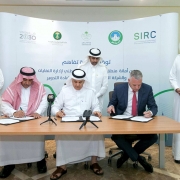
(Published in GLOBAL RECYCLING Magazine 2/2024, Page 3, Photo: National Center for Waste Management (MWAN))