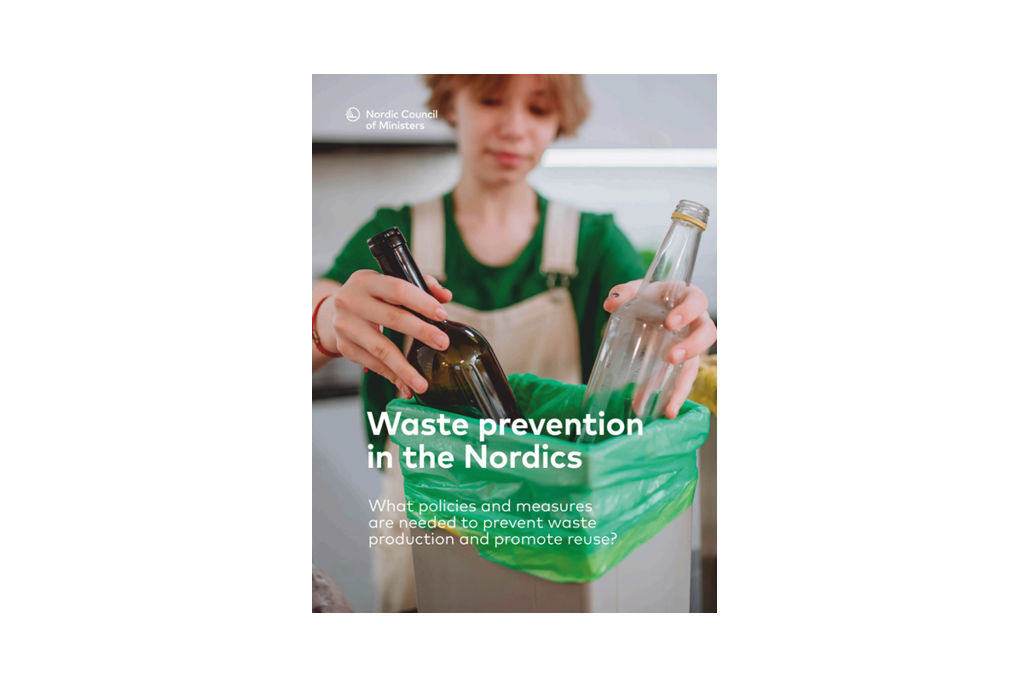
Recommendation for the Nordic Countries: Stronger Waste Prevention Measures
In a new report commissioned by the Nordic Council of Ministers’ Nordic Working Group for Circular Economy, Sweco – one of Europe’s leading architecture and engineering consultancies – recommends more measures.
The study, which aimed to identify realistic and effective measures to strengthen waste prevention and the promotion of reuse in the Nordic region, suggests that the governments of Sweden, Denmark, Norway, Finland and Iceland, as well as the Faroe Islands, Greenland and Åland should implement more systematic waste prevention strategies to achieve regional and national sustainability goals. “The report outlines practical measures to strengthen the circular economy in the Nordics, with a particular focus on waste prevention and reuse,” Sweco (w swecogroup.com) informed.
As stated, the Vision 2030 is to turn the Nordic region into the most sustainable and integrated region in the world. The Nordic countries would have programs and plans in place that include improved waste management as one element of realizing that vision. In addition to the Nordic ambitions, several recent EU regulations are focusing on minimizing waste in several segments of product value chains. Given global climate and biodiversity challenges, the Nordic Council of Ministers had engaged an internationally active architecture and engineering consultancy to provide expert recommendations on accelerating waste prevention across the region. “The project, which centers on municipal waste, was conducted by a team of Sweco experts from Finland, Sweden, Denmark, and Norway.”
According to the study titled “Waste Prevention in the Nordics”, the team evaluated and analyzed prevention and reuse measures with a focus on their impact (reducing the quantity of waste, reducing the adverse impacts of waste and/or harmful substance content) and feasibility (ease of implementation and monitoring as well as applicability to the Nordic region). “Within municipal waste, the waste fractions of textiles, consumer electronics, and plastic packaging were specific focus areas.”
In the Nordic countries, there is no systematic approach to implementing waste prevention and reuse policy, the expert team gave account. “An in-depth case study on economic steering instruments was conducted for the textiles value chain. It looked into the potential of implementing value-added tax (VAT) reductions for repair services and secondhand products, fees for fast fashion, and research and development (R&D) funding for developing new circular business models.”
Transitioning to a circular economy
The study would emphasize that transitioning to a circular economy requires a fundamental shift from recycling-focused policies to a holistic approach that addresses the entire product lifecycle. “Sufficiently stringent economic instruments are critical for overcoming the market and cultural barriers that sustain linear economies. However, economic measures alone are rarely impactful enough when implemented in isolation. Instead, policymakers must adopt a comprehensive ‘toolbox’ approach, combining multiple measures rather than relying on any single solution to drive significant change,” the executive summary informed.
“The study concludes that achieving the Nordic Vision 2030 of becoming the world’s most sustainable and integrated region necessitates a well-designed policy mix. This includes aligning extended producer responsibility (EPR) with economic and regulatory measures, supported by informational guidance, to create a favorable environment for a circular economy.” Additionally, targeting the early stages of the product lifecycle would be crucial for addressing waste prevention effectively.
More information about the study: https://pub.norden.org/temanord2025-502/temanord2025-502.pdf
(Published in GLOBAL RECYCLING Magazine 2/2025, Page 27, Source: The Nordic Council of Ministers)