
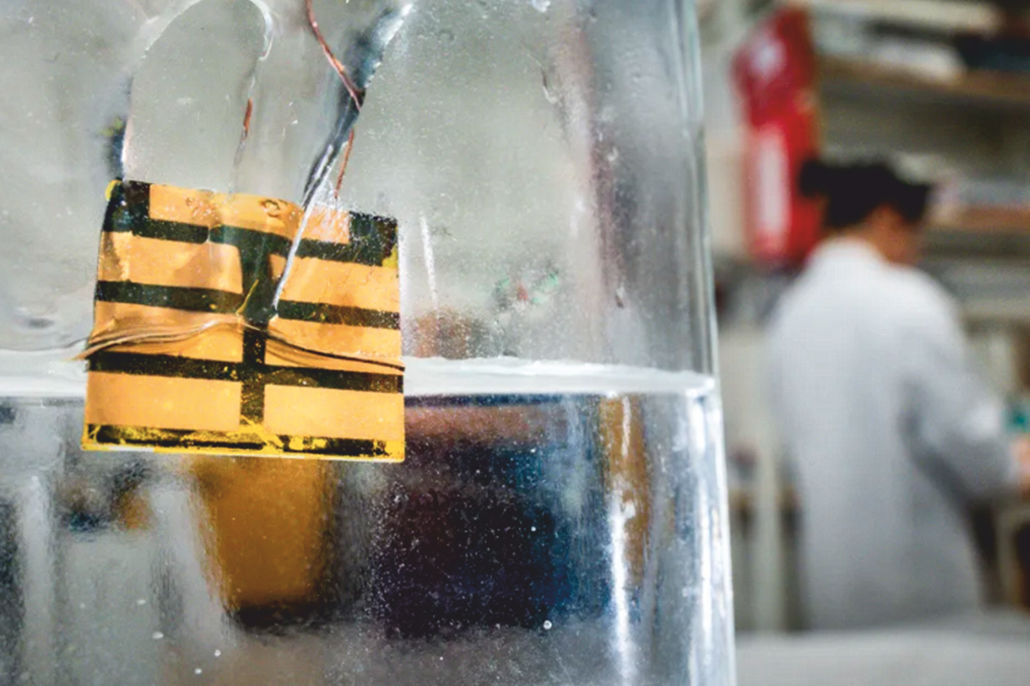
The Next-Generation Solar Cell will be Fully Recyclable
According to Swedish Linköping University, researchers of the university have developed a method to recycle all parts of a solar cell repeatedly without environmentally hazardous solvents. “The recycled solar cell has the same efficiency as the original one,” the press release said. “The solar cell is made of perovskite and the main solvent is water.”
Electricity use is expected to increase drastically in the coming years with the development of AI and the transition to electrified transport, among other things, the university stated. For the change to not drive climate change, different sustainable energy sources would need to work together. Solar energy has long been considered to have great potential and solar panels based on silicon have been on the market for over 30 years. However first-generation silicon solar panels are at the end of their life cycle, which has created an unexpected problem. “There is currently no efficient technology to deal with the waste of silicon panels. That’s why old solar panels end up in the landfill. Huge mountains of electronic waste that you can’t do anything with,” Xun Xiao, a postdoc at the Department of Physics, Chemistry and Biology (IFM) at Linköping University (LiU), was cited. Feng Gao, professor of optoelectronics at the same department, assisted: “We need to take recycling into consideration when developing emerging solar cell technologies. If we don’t know how to recycle them, maybe we shouldn’t put them on the market at all.”
Promising technology for recycling
One of the most promising technologies for next-generation solar cells involves perovskite (editor’s note: a calcium titanium oxide mineral composed of calcium titanate, with the chemical formula CaTiO3). According to the information, they are not only relatively inexpensive and easy to manufacture but also lightweight, flexible, and transparent. Thanks to these properties, perovskite solar cells could be placed on many different surfaces, even on windows. Also, they could convert up to 25 percent of the solar energy into electricity, which can be comparable to today’s silicon solar cells. “There are many companies that want to get perovskite solar cells on the market right now, but we’d like to avoid another landfill. In this project, we’ve developed a method where all parts can be reused in a new perovskite solar cell without compromising performance in the new one,” Niansheng Xu, postdoc at LiU, was quoted.
However, given that perovskite solar cells currently have a shorter life span than silicon solar cells it is important that perovskite solar cell recycling is efficient and environmentally friendly, the university underlined. “Perovskite solar cells also contain a small amount of lead that is necessary for high efficiency, but this also places great demands on a functioning recycling process.” In addition, there were also legal requirements in large parts of the world for producers to collect and recycle end-of-life solar cells sustainably.
As reported, there are already methods for dismantling perovskite solar cells. “This mostly involves using a substance called dimethylformamide, a common ingredient in paint solvents. It is toxic, environmentally hazardous, and potentially carcinogenic.”
The Linköping researchers have instead developed a technology where water can be used as a solvent in dismantling the degraded perovskites. “And more importantly, high-quality perovskites can be recycled from the water solution.” According to Xun Xiao, the researchers at Linköping University can recycle everything – covering glasses, electrodes, perovskite layers, and the charge transport layer. The next step for the researchers is to develop the method for larger-scale use in an industrial process. In the long term, they believe that perovskite solar cells can play an important role in providing energy when surrounding infrastructure and supply chains are in place.
The study – published in Nature (https://www.nature.com/articles/s41586-024-08408-7) – was funded by the Knut and Alice Wallenberg Foundation, the Wallenberg Initiative Materials Science for Sustainability, The Swedish Energy Agency, and through the Swedish Government’s strategic area in advanced functional materials, AFM, at Linköping University. Researchers Xun Xiao, Niansheng Xu, and Feng Gao have applied for patents on the technology described above.
(Published in GLOBAL RECYCLING Magazine 2/2025, Page 36, Photo: Thor Balkhed / Linköping University)