GLOBAL RECYCLING
  • Home
  • Magazine
  • Articles
    • Business Chances
    • Enterprises
    • Newsflash
    • Markets
    • Machinery
    • Processing Methods
  • Advertiser
  • Events
  • Media Kit
  • Imprint
  • Click to open the search input field Click to open the search input field Search
  • Menu Menu
  • Link to X
  • Link to Facebook
  • Link to Instagram
  • Link to LinkedIn
  • Link to Rss this site

Researchers at TU Graz Turn Textile Waste into Paper

The idea is not new, but was now rediscovered: Researchers at the Austrian Technical University of Graz have found a way to recover the cellulose fibers from used clothing and utilize them to produce cardboard and other packaging materials.

As reported by the university, in Austria alone around 220,000 tons of textile waste is produced every year, of which almost 80 percent is incinerated. As a result, valuable raw materials are lost. A team led by Thomas Harter from the Institute of Bioproducts and Paper Technology has come up with a solution to this problem. The researchers have developed a process to recover the fibers from cotton-based used textiles and use them to produce paper for packaging materials.

According to Thomas Harter, technically converting textile fibers into paper is a downgrade. “However, it has a major advantage from an environmental point of view. The paper cycle is highly closed, with recycling rates of over 90 percent in the packaging sector. If we bring valuable textile fibers into this cycle, they remain usable for a long time.” Recycled textiles could be an important source of raw materials for the production of packaging paper and help to reduce the amount of paper imports currently used for this purpose.

Very similar to normal papermaking suspension
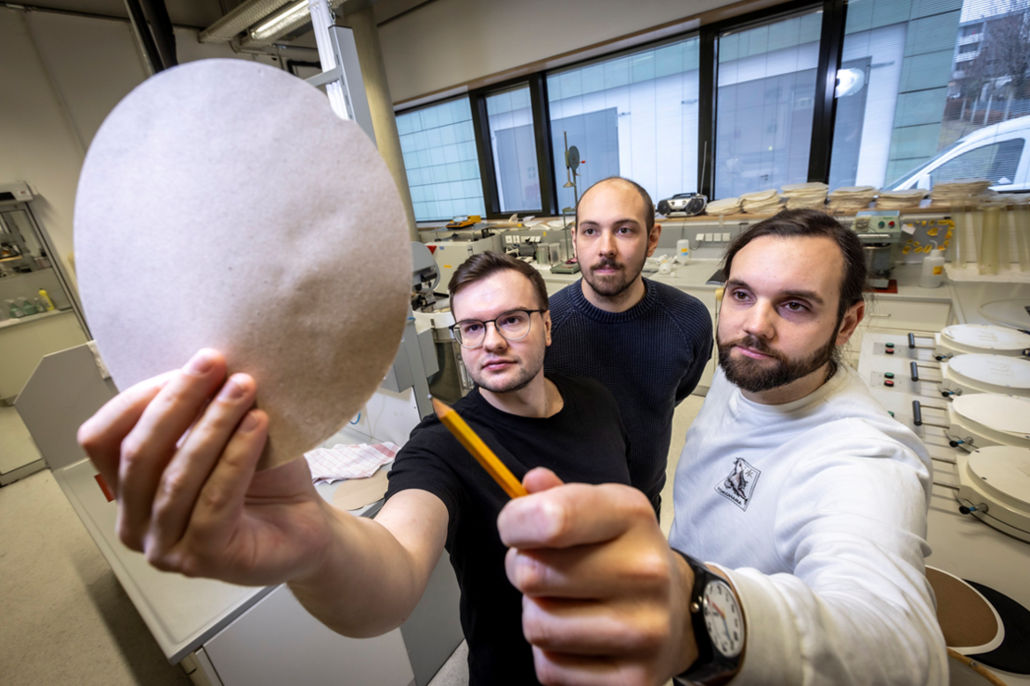
To make paper from old items, clothing is cut into small shreds and soaked in an aqueous solution. This mixture of water and shreds is milled to separate the interwoven cotton fibers without knotting or clumping. As part of his master’s thesis, Alexander Wagner determined the most suitable beating machine, the necessary processing time, and the optimum ratio of water to textiles to extract the maximum amount of usable fibers from the textile waste. “At the end of our tests, we obtained a suspension that is very similar to a normal papermaking suspension and that we can process into paper using established methods,” Thomas Harter was quoted.

Significantly more tensile strength than conventional recycled paper
As described by TU Graz, the paper with textile content hardly differs from ordinary recycled paper; it is slightly brownish with occasional colored speckles, which come from colored clothing. However, these splashes of color were irrelevant for carton boards and other packaging materials. Tensile tests have shown that the addition of textiles increases the strength of recycled paper. “Even with a textile-based proportion of 30 percent, the paper is significantly stronger, while the processability remains the same,” Alexander Weissensteiner informed, who is also working on optimizing the recycling process as a master’s student. This would be due to the length of the fibers. “The fiber lengths of recycled waste paper are quite short. At 1.7 millimeters, our recycled textile fibers are significantly longer.”

The researchers’ next goal is to reduce the energy consumption of the beating process. In addition to additives such as light acids and alkalis, they also test enzymatic pre-treatments to support fiber disintegration in the beating unit. “We also want to take the next scaling step and implement the process on industrial devices,” Thomas Harter stated.


Paper made from Cotton

Cotton paper, also known as rag paper or rag stock paper is made using cotton linters (fine fibers that stick to the cottonseeds after processing) or cotton from used cloth (rags) as the primary material, the online dictionary Wikipedia informs. “Prior to the mid-19th century, cotton paper was the main form of paper produced, with pulp paper replacing cotton paper as the main paper material during the 19th century.” Cotton paper is more durable, “and consequently important documents are often printed on cotton paper.”

Today, cotton paper is still produced and available. According to China-based manufacturer of pulp and paper making machinery CNBM, the spectrum ranges from writing and printing paper to currency and security paper.


tugraz.at

(Published in GLOBAL RECYCLING Magazine 2/2025, Page 37, Photo: Lunghammer / TU Graz)

3,667
Share this entry
  • Share on Facebook
  • Share on X
  • Share on WhatsApp
  • Share on Pinterest
  • Share on LinkedIn
  • Share on Tumblr
  • Share on Vk
  • Share on Reddit
  • Share by Mail
https://global-recycling.info/wp-content/uploads/2025/06/recycled-cotton-fibers-225.jpg 686 1030 msv2016 https://global-recycling.info/wp-content/uploads/2023/12/GR-Logo-250-100.png msv20162025-08-12 08:03:372025-06-23 14:06:44Researchers at TU Graz Turn Textile Waste into Paper
You might also like
Re-Gen MD Endorses Infrastructure Minister’s Decision on the ARC21 Planning Application
Paper Market Analysis: Focus on Pathways for Carbon Neutral Manufacturing
DS Smith to Build new Paper Machine in Italy
Philippines’ Waste and the Ban of Incineration
Case Study of Triveni Turbine Limited on Sustainable Energy from Waste using RDF Production: First Waste to Energy plant in Germany
Unlocking Private Climate Finance in Emerging Markets

AD

Translation

GLOBAL RECYCLING

The Magazine for Business Opportunities & International Markets.

Global trends in the circular economy, particularly in the recycling and recovery industry as well as in waste recycling. Markets for technology, logistics and raw materials.
© MSV Mediaservice & Verlag GmbH
Privacy Policy

Check out our websites

EU-Recycling
Recyclingportal

Topics

Business Chances, Enterprises, Newsflash, Markets, Machinery, Processing Methods and Events.
In general: Recycling Industry, Circular Economy, Recycling Technology, Secondary Raw Material, Recycling, Recycling Markets, Collection, Reuse, Waste, Waste Management, Industrial Waste, Automobile Recycling, Scrap, C&D Waste, Electronic Scrap Recycling, Screening Machines, Separator, e-Waste, Sorter, Sensor Sorter, Splitter, Crusher, Shredder, Magnetic Separators, Metal Recycling, Ferrous, Non-Ferrous, Plastic Recycling, Scrap Recycling, Wastepaper, Plastic Waste, Second Hand Clothing, Textile Waste, Tyres, Hazardous Waste, Waste Processing Plants, Waste Legislation and much more.

Tags

AI aluminum batteries BIR China circular Circular Economy collection E-Waste economy energy EuRIC Europe FEAD Global Recycling Foundation India Industry landfill management metal metals packaging Paper PET plant plastic plastics Plastic Waste recovery Recycling Scrap Shredder shredding sorting steel sustainability Sustainable technology Textile Textiles USA waste waste management wastewater WEEE
Link to: The Next-Generation Solar Cell will be Fully Recyclable Link to: The Next-Generation Solar Cell will be Fully Recyclable The Next-Generation Solar Cell will be Fully Recyclable Link to: Scrap Dealer with New 830 G Material Handler Link to: Scrap Dealer with New 830 G Material Handler Scrap Dealer with New 830 G Material Handler
Scroll to top Scroll to top Scroll to top