Sweden: More Circular Economy Can Save Billions
According to the study “Circularity Gap Report (CGR) The Value Gap: Sweden”, the country is losing more than 54 billion Euro (or about 600 billion Swedish Krona) each year due to linear economy practices. This sum of money corresponds to 19 percent of the total economic value created in the country and is equivalent to 57 percent of the national state budget.
“The majority of goods reaching their end of life are not reused, refurbished, or recycled – a main channel through which value leaks away. Transitioning to a circular economy could enable Sweden to capture the unrealized value,” a press release informed. The study, produced by RISE Research Institutes of Sweden and Circle Economy and funded by the Swedish innovation program RE:Source, would provide evidence of the economic inefficiencies inherent in a linear economy, reinforcing the economic case for circular transition.
“Historically, we have measured prosperity by the value we create. Few have looked at the value we are losing,” Ann-Charlotte Mellquist, project manager and researcher at RISE, was quoted. “Our economy is leaking, and the Value Gap shows us where those leaks are and how much they cost. As reported, products discarded too soon are Sweden’s largest source of lost value, costing the country about 38.3 billion Euro annually. Extending product lifespans through reuse, refurbishment, and remanufacturing could recover much of this loss. Klas Cullbrand, Innovation Leader at RE:Source, could not agree more. “The majority of goods reaching their end of life are not reused, refurbished, or recycled. By failing to give products and materials long lifespans, we waste not only the materials themselves but also the energy, labor, and infrastructure invested in them – the very value we work so hard to create.”
In addition, overconsumption – spending that exceeds actual needs or offers minimal benefit – amounts to – converted – 18.2 billion Euro annually. “This is roughly four times the amount Sweden planned to allocate for development aid to the world’s poorest countries in 2025,” Circle Economy stated.
When comparing economic sectors, construction stands out as the largest source of value loss, amounting to 16.4 billion Euro (or 180 billion Swedish Krona), the information said. “The majority of this loss occurs when buildings are demolished, and their embedded value is discarded.” The second-largest source of value loss is consumer goods like textiles, electronics, plastic packaging, and furniture. Each year, an estimated worth (eight billion Euro or 88 billion Swedish Krona) of these goods becomes waste, while they could have remained in circulation within a more circular economy.
The report recommends the following actions to reduce value loss and better capture circular opportunities in Sweden:
- Introducing policies that recognize environmental and social value, such as repair subsidies, tax incentives for reuse, and circular procurement rules.
- Incentivizing circular business models like product-as-a-service, reuse platforms, and industrial symbiosis (when by-products or waste of one industry are used by another industry).
- Promoting conscious consumption by embedding circularity into education, culture, and regulation.
“While this report examines the Swedish economy, its findings are relevant beyond the country’s borders. It demonstrates that the linear, ‘take-make-waste’ models are not only environmentally harmful, but also economically weak. This presents a strong business case for the circular economy, which can unlock billions in untapped value – in Sweden and globally”, Ivonne Bojoh, CEO at Circle Economy, is convinced.
The report can be downloaded at: dashboard.circularity-gap.world/report/sweden-value-gap/executive-summary
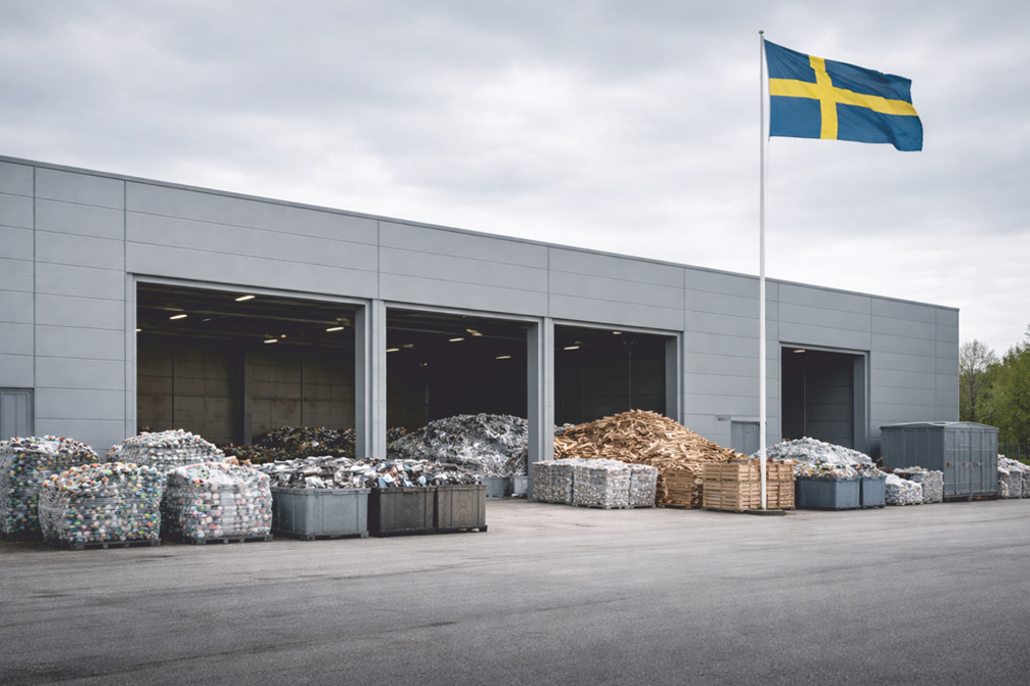
(Published in GLOBAL RECYCLING Magazine 1/2026, Page 6, Photo: MSV, AI-generated)