
China Aims at More Circular Economy
In China, the National People’s Congress approved the 15th Five-Year Plan (2026-2030) in March. It outlines – inter alia – the country’s targets regarding its green transformation, meaning circular economy and decarbonization.
Regarding circular economy and urban municipal waste, which accumulated to 260 million tons nationwide in 2024, the People’s Republic of China plans to realize “zero-waste” cities like Hangzhou. In January this year, the Chinese state news agency Xinhua informed that the city – with an annual economic output exceeding two trillion yuan (about 287 billion US-Dollar) and a population of more than 12.6 million – has been selected as one of the “20 Cities Towards Zero Waste” by the United Nations Secretary-General’s Advisory Board on Zero Waste in 2026. The board noted that the city stands out for its strong commitment to zero-waste and its contributions to advancing inclusive, sustainable, and innovative waste management solutions.
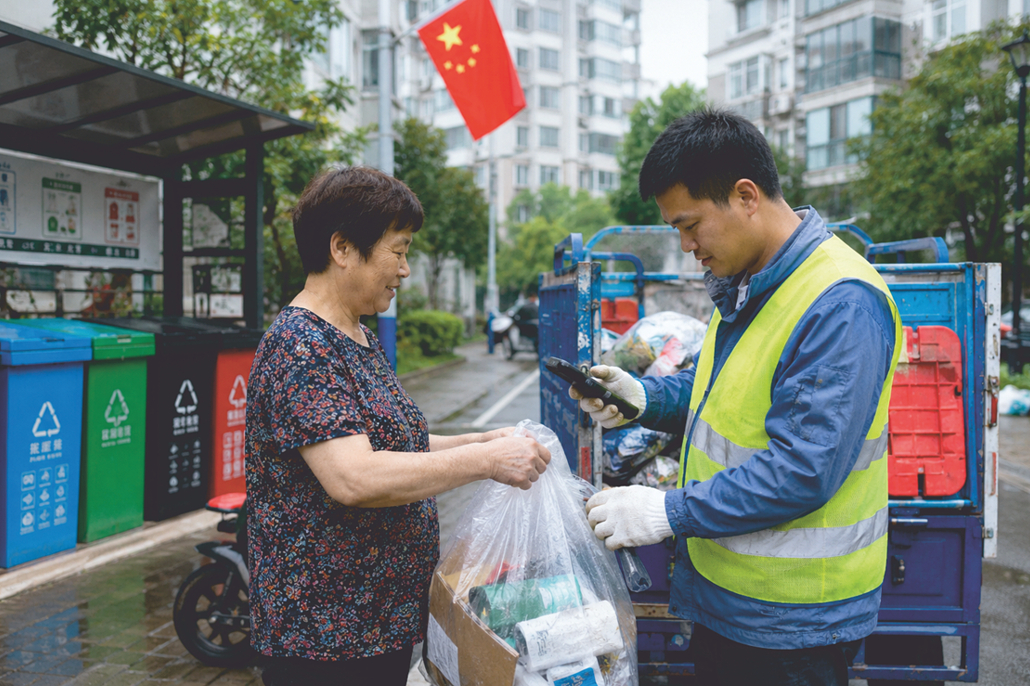
“In Hangzhou, waste now carries a ‘digital passport’. Huge Recycle, a company in Yuhang District handling household waste recovery and recycling, operates a smart recycling network. Data from every stage – from collection at homes, sorting and processing, to delivery to downstream partners – is fed in real time into the company’s intelligent management platform,” Xinhua gave account. “Residents are encouraged to place used cartons, bottles and other recyclables into dedicated collection bags and schedule a pickup online. Collectors from the company arrive promptly, scan the items and upload the data, allowing residents to instantly earn redeemable eco-points that can be exchanged for goods.”
According to the information, the low participation in the beginning has been overcome by a simple and rewarding system. Since its launch, the system has handled over 21 million pickups in Yuhang district, collecting nearly 600,000 tons of household waste. “At Hangzhou’s urban management bureau, a digital platform maps the city’s entire waste system, covering 10,806 collection points, 1,785 sanitation vehicles, 10 incineration plants and 14 organic waste treatment facilities.” The model would now spread beyond Hangzhou. “In Shanghai’s Xuhui District, a live digital map tracks hundreds of disposal sites, monitoring sorted waste volumes and recycling rates.”
Furthermore, several major cities were now processing household waste using smart solutions, Professor Yan Jianhua at the College of Energy Engineering, Zhejiang University, was quoted. With landfills no longer in use, some cities would transform old sites to improve the environment and recover valuable resources.
Rapid development
Like many fast growing metropolitan areas around the world, Hangzhou had to cope with huge volumes of waste and insufficient processing capacities. According to Xinhua, in 2013, the city generated more than three million tons of household waste. “If piled onto a standard football pitch, it would measure at least 400 meters in height, taller than a 140-story building.” In 2018, the situation improved with the launch of the eco-industrial park by Hangzhou Linjiang Environmental Energy Co., Ltd. By the end of 2020, the facility was able to process two million tons of household waste annually, generating over one billion kilowatt-hours of electricity and transforming the resulting slag into eco-friendly construction materials, the state news agency underlined.
Moreover, in the city’s Fuyang District, “a centuries-old mining site has been transformed into an eco-park where nine enterprises carry out industrial symbiosis. Steam from waste incineration heats a neighboring company, saving two million yuan in annual costs. Food waste, after oil and biogas extraction, is used to feed black soldier flies, producing high-protein animal feed. The park’s output value is projected to have hit 1.3 billion yuan in 2025.” As per Hangzhou’s Ecology and Environment Bureau, 71.8 percent of the city’s household waste is recycled and over 98 percent of general industrial solid waste has become useful.
Management Action Plan: Promoting the application of recycled materials
At the beginning of 2026, China’s State Council had issued its “Comprehensive Solid Waste Management Action Plan”, the Chinese website “Mysteel.net” informed. Its goal: accelerating the low-carbon transformation for domestic economic and social development. The objective is the annual comprehensive utilization of 4.5 billion tons of solid waste by 2030, and the annual recycling volume of 510 million tons of key renewable resources, along with an effective improvement in the overall standard of solid waste governance. For this purpose, the People’s Republic of China intends to “improve the management system for recycled materials and introduce more supportive policies to promote the development of the circular economy”.
For example, China aims to achieve an annual recycling volume of over 300 million tons for steel scrap and 80 million tons for wastepaper, as well as more than 25 million tons of secondary nonferrous metals and 19.5 million tons of recycled plastics by 2030, the information said. By 2025, the country’s total steel scrap recycling volume had been around 255 million tons, while that of waste paper was 72.5 million tons.
“The country’s central government will further enhance the supply of renewable resources by promoting technological upgrades and building more processing and distribution centers, according to the action plan,” Anthea Shi wrote in January this year. “Meanwhile, to boost resource utilization, the government will encourage key industries such as automotive, electronics, batteries, and textiles manufacturing to use more recycled raw materials in their production processes, the plan mentioned.”
Environment and energy: implications for businesses
As reported by the company Dezan Shira & Associates (a pan-Asia, multi-disciplinary professional services firm that assists foreign investors throughout Asia) in the publication “China Briefing”, the new Chinese Five-Year Plan would involve possible tightening of environmental standards for businesses and investors. However, it also means “the expansion of a range of new opportunities across both ‘traditional’ renewable supply chains and emerging carbon and energy technology”.
As implications for businesses operating in the country, the plan for 2026 to 2030 could stand for challenges. “The planned introduction of product carbon footprint accounting rules, carbon emission limit standards, and a product carbon labeling certification system will create new tracking and disclosure obligations for manufacturers,” the information said. As energy efficiency requirements are also set to tighten, firms in energy-intensive industries can therefore anticipate assessments that are more rigorous and benchmarking against set standards. “The expansion of the national ETS will be among the most consequential developments for carbon-intensive industries,” the authors wrote. “The shift from an intensity-based system to one with absolute emissions caps, combined with a gradual increase in the share of paid allowances, will raise the cost of carbon for covered industries and bring more sectors into mandatory participation.” By contrast, businesses that have invested in decarbonization and clean production would benefit competitively “as standards tighten and carbon costs rise across the economy”. For foreign investors, there are opportunities, although Chinese companies already dominate some renewables sectors, such as wind and solar manufacturing, making entry for foreign companies difficult. “However, the scale of investment needed to transition China’s economy off fossil fuels means there are still a wide range of opportunities across the value chain,” Dezan Shira & Associates underlined. “The build-out of renewable energy infrastructure, zero-carbon industrial parks, and west-to-east transmission networks will drive sustained demand for specialist equipment, engineering services, and advanced materials, while in certain sectors, such as offshore wind and nuclear power, there is still demand for foreign expertise.” The push to develop new energy storage, hydrogen energy, carbon capture, utilization, and storage (CCUS), and next-generation nuclear technologies under the plan’s “future industries” agenda would present longer-term opportunities for foreign firms with capabilities in these areas, where China is actively seeking to accelerate innovation and international collaboration.
New catalogue
As emphasized by Dezan Shira & Associates, foreign investors in these areas are also actively encouraged under China’s “Catalogue of Industries Encouraged for Foreign Investment”, which includes a range of green and clean technology sectors. China’s National Development and Reform Commission (NDRC) and the Ministry of Commerce (MOFCOM) officially released it. More information regarding investment in China is available at fdi.mofcom.gov.cn/EN/come.html.
mysteel.net, china-briefing.com
(Published in GLOBAL RECYCLING Magazine 2/2026, Page 16, Photo: MSV, AI-generated)