Cyprus’ Waste Management: Political Will Wanted
Municipal waste generation per capita in Cyprus slightly decreased between 2010 and 2022, says the European Environment Agency in its latest report of the country‘s waste management profile. However, the Cyprus Mail newspaper offered a contrasting viewpoint in August 2025, headlining: “Cyprus is a potpourri of environmental neglect.”
The facts: According to numbers of the local Statistical Service, the total amount of municipal solid waste in Cyprus in 2023 reached 625,000 tons. “From the total amount of 496 thousand tonnes treated in 2023, 76,8 percent was disposed in landfills, 16,3 percent was used for recycling, 3,2 percent was used for energy recovery purposes and 3,7 percent was composted.” From 2010 to 2023, landfilling officially dropped from 497,860 to 381,05 tons, while recycling rose from 65,530 to 81,120 tons, composting from zero to 18,510 tons and energy recovery from zero to 15,650 tons. A look at the recycling numbers shows: Except of treatment of paper, paperboard and cardbord (44,200 tons), the recycling degrees for plastic (8,310 tons), glass (8,360 tons), metal (12,070 tons), wool (2,000 tons) and textile (2,810 tons) were low.
No capacities
The Early Warning Report Cyprus of the EU Commission made it clear: “Cyprus has no waste incineration plants nor capacity for waste incineration”, the report informed. “The residual municipal waste is treated at MBT plants” and – due to the lack of local recycling facilities – “outputs are landfilled or exported for recycling”, while the exported amounts are included in the reported recycling data. At least Cyprus was considered to be at risk of missing the 2025 target of 55 percent for preparing for re-use and the recycling of municipal waste; it was also at risk of missing the 2025 target to recycle 65 percent of packaging waste, not to forget the gap between the 2035 target to landfill of ten percent.
On August 5, 2025, a new report occured which scrutinised the agriculture ministry. According to the Cyprus Mail website, the paper – meanwhile somewhere hidden at the ministry server and only available in Greece – “follows up on issues that emerged in previous audits”. Nevertheless, the report enumerated the start of the Lakatamia Environmental Information Centre without an environmental impact study, illegal interventions in the Kryos and Amathos rivers, the illegal construction on a livestock unit within a Natura 2000 zone, the illegally operation of a bio-sewerage plant in Kalopanayiotis and long-standing controversies over unauthorized activities and construction projects on the Akamas peninsula – one of the island’s most ecologically valuable areas.
Landfills – not properly sealed off
The report also found out, that through a change in urban planning status a specific company in Kouklia was favoured. The audit at Ayia Thekla near Waterpark Ayia Napa identified “permit violations”, “additions without approval to tourism developments” and building of holiday homes “without the relevant permits”. Regarding the contentious landfills at Vati and Kotsiatis, the website of Cyprus Investigative Reporting Network (CIReN) presented more details: The waste activities at both localities had to be shut down at 2013, but had not been properly sealed off yet; the completions are now expected in 2026 and 2029. All in all CIReN judjed: “The Cypriot government has been in violation of the Directive on the Landfill of Waste (Directive 1999/31/EC) since the very first day of its accession to the European Union – a period of 21 years.”
A green start
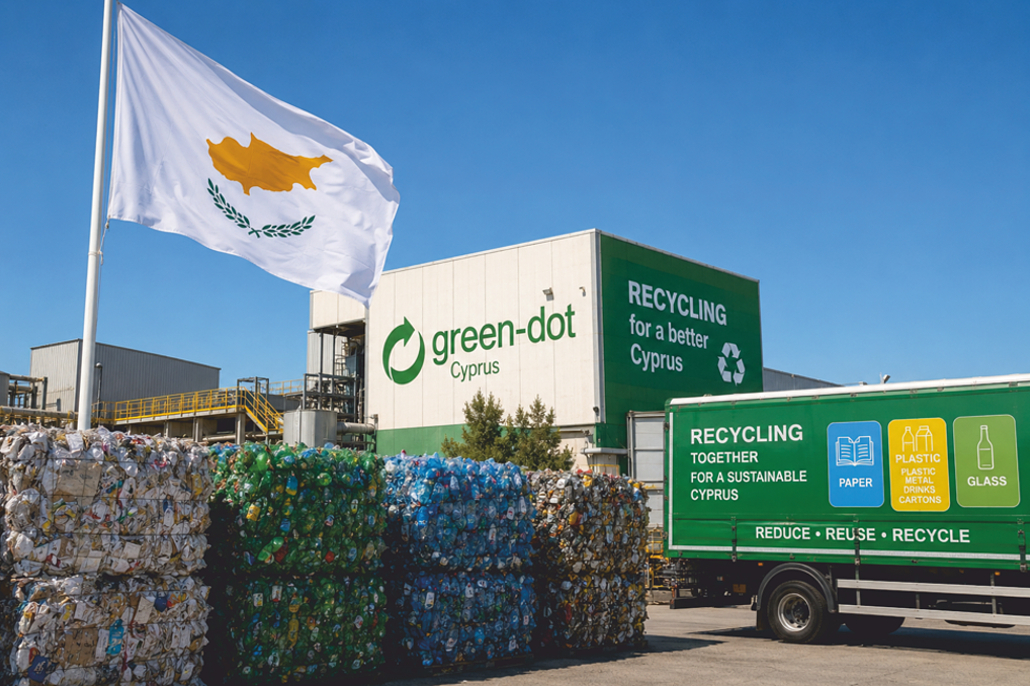
Not so the NGO Green-Dot. The group started up the first collecting system on the island in 2005 and was licensed in 2006. The group gathered separate paper, glass, certain metals and plastics at sorting plants where they managed some twelve tons of recycled waste per day. The waste was then baled and exported abroad for recycling. Looking back, the company resumed: “Prior to the launch of Green Dot in 2007, all waste was treated as rubbish and dumped in landfills. Cyprus was at the bottom of European Union’s recycling table.” And even in 2017, in a video-clip published by the AFP News Agency, Kyriakos Parpounas, Consultant for NGO Green-Dot, had to confess: “You can see that in the comparative tables Cyprus is one of those countries that has no legal and no financial tools that actually help the growth of recycling.”
Today Green-Dot’s EPR scheme covers both household and non-household sources for all packaging material categories. It collects and manages PMD (plastic packaging, metal packaging, beverage cartons), wood, paper and glass fractions. According to the company, relying on estimates outlined by the Statistical Service, solid waste produced in Cyprus in 2021 accounted to 570,000 tons, of which only 455,000 tons are managed: 354,30 tons finally disposed, 80,39 tons recycled, 6,87 tons composted and 13,93 tons recovered for energy, leaving 114,521 tons “unmanaged”. Green Dot‘s primary responsibility lies within the management of recyclable packaging, says the company, serving eight municipalities and 62 communities: “PMD, packaging paper and non-packaging paper are separately collected door-to-door from 94 percent of the total population covered by the Green Dot system (630,000 inhabitants), whereas the remaining six percent (40,000) are serviced via bring points only, covering mainly schools, industrial areas or stores.”
The two MBT-plants
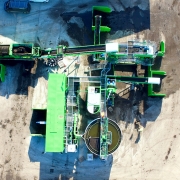
For further use of waste, there are two mechanical-biological treatment plants. In 2018, the Koshi plant extracted 3,177 tons of paper and cardboard and 3,228 tons of plastics and sent it to other Member States; additionally 927 tons of paper and cardboard, 1,632 tons of metals, 697 tons of glass, and 236 tons of plastics were first pre-treated in Cyprus and then exported outside the EU for further treatment. Correspondingly, the Pentakomo plant extracted 10,216 tons of paper and cardboard, 1,587 tons of ferrous metals, 847 tons of aluminum, 1,096 tons of glass, and 6,925 tons of plastics in 2019, which the Department of Environment declared as “exported for further treatment”. (By the way: The Pentakomo plant, built by 46 million Euro of the European Union, was planned to recycle the waste collected locally and use some of it to make fuel, but not buyers for fuel could be found, reported online-newspaper Politico.)
Fifth highest for municipal waste
Anyway, the early warning assessment in 2023 by the European Environment Agency prospects a risk for not meeting the targets for aluminum, glass and plastics packaging as well as the municipal waste and the landfill waste targets. And the Cyprus News indicates that Cyprus ranks fifth highest in EU for municipal waste, with over 75 percent landfilled. On contrary, the Cyprus Recovery and Resilience Plan 2021-2026 aims to foster sustainable recovery and enhance the country’s resilience and preparedness through targeted investments and reforms: Establishing a coordinating body between central and local government, creating a network of collection points and recycling hubs, supporting an integrated waste separation system and implementing a Pay-as-you-throw-scheme (planned in February 2026).
No shortage of plans
In parallel to the (revised) National Waste Generation Prevention Programme 2022-2028, a Municipal Waste Management Strategy 2022-2028 together with local Municipal Waste Prevention and Management Action Plans are foreseen. By the way: The naming of the initiatives is confusing. The 2012 Management Plan for Household and Similar Type of Waste was changed into the 2015-2021 Municipal Waste Management Plan. At the same time, a summary description of the Municipal Waste Management Plan entitled “Municipal Waste Management Strategy” was prepared for the period 2015-2021. It must not be forgotten, that Cyprus already adopted a National Action Plan for the Circular Economy 2021-2027, financed among many others by 13.3 million Euro for a “Plan to boost investment in a circular economy by business” for “a comprehensive proposal for the implementation of investment proposals”, 25 million Euro for the “techno-economic support of local authorities for the establishment of a separate collection system for municipal solid waste” and – among several smaller projects like the program for the prevention, separate collection and recovery of municipal waste for the mountainous areas of Cyprus (Budget 1.4 million Euro) – 6.4 million Euro for the “Solid Waste Reduction Programme for the Coastal Hotel and Related Tourism Infrastructure”.
Tourism and waste
Besides the forthcoming problems concerning the implementation of these plans there is another difficulty: the tourism. In 2016, more than three million people visited the island. AFP reported in a video clip that a five-star hotel in Ayane is trying to promote sustainable tourism: Since 2003, guests have been asked to sort their rubbish and cut the level of landfill per guest by half. But the rising number of tourists makes this increasingly difficult and reached its peak in 2025: 4.53 million. Panicos Michael, Hotel Manager in Ayia Napa, commented already in 2016: “I think that this will be a big challenge for the island and for them (the tourists) in general to cope with the increased amount of waste”. Meanwhile, several projects are currently implemented by the Cyprus Sustainable Tourism Initiative in the tourism sector, for example, the “Keep our Sand and Sea Plastic Free initiative”. (In a study conducted by IUCN in 2020, it was estimated that Cyprus’ contribution to marine plastic leakage was around 760 tons.)
Investments are needed
There might be the idea that investing in the Cyprus waste sector could be highly attractive due to mandatory EU compliance targets. And that high landfill rates are driving urgent government investment. One should be warned. Not only does the aforementioned report show that good investment does not necessarily end in good results. Although Investment banker Smergers lists 493 “Waste Management Investors” in Cyprus (whatever their task is): The investment must be precise. The European Environment Agency advises among others: “Targeted public policies with clear long-term objectives for investment planning and innovation are … needed.” And the Friedrich Ebert Stiftung gives the hint that “key measures, such as the implementation of the ‘Pay-As-You-Throw’ Scheme, the expansion of waste separation infrastructure, and enhanced public engagement, are vital for reducing waste and increasing recycling rates. Additionally, investments in modern waste treatment facilities and capacity-building initiatives will further strengthen these efforts.”
One comment: In 2016, in a video-clip by Euronews, Natasa Ioannou from Friends of the Earth – Cyprus, walking through waste diverted as far as the horizon, not only felt “anger and disappointment” about “something going wrong”, but she also assumed a “lack of political will”. Political will today seems to be more necessary than ever.
(Published in GLOBAL RECYCLING Magazine 2/2026, Page 19, Photo: MSV, AI-generated)