Zambia’s Claimed Destination: Green Growth
The Republic of Zambia is progressing towards a circular economy as part of its National Green Growth Strategy.
In April 2026, the country’s government signed a Host Country Agreement (HCA) with the Global Green Growth Institute (GGGI), an intergovernmental organization founded at the United Nations Conference in 2012 on Sustainable Development and based in Seoul, South Korea. As reported, the agreement reaffirms the parties’ shared commitment to advancing climate action and inclusive green growth in Zambia. It would formalize GGGI’s legal status in Zambia and strengthen the institutional framework for collaboration, supporting Zambia’s government to deliver its climate and green growth priorities, including implementation of its Nationally Determined Contributions (NDCs). GGGI Zambia is hosted by the Ministry of Green Economy and Environment.
The Zambian government and GGGI have been working in close collaboration for years. The Global Green Growth Institute has worked with government counterparts across multiple ministries and agencies to support initiatives including the National Green Growth Index, the National Green Growth Strategy, carbon markets under Article 6, operationalization of an integrated Monitoring, Reporting and Verification (iMRV) system, capacity building, and the establishment of a Climate Finance Unit.
The National Green Growth Strategy 2024-2030 was launched in April 2024. According to international organization NDC Partnership, it is a landmark initiative aimed at transitioning the nation towards a green economy by fostering low-carbon, resource-efficient, resilient and socially inclusive growth. “The National Green Growth Strategy is a comprehensive framework designed to align Zambia’s development pathways with principles of sustainability and inclusivity, centering on four pillars: (1) resilient and climate-compatible growth, (2) enhanced resource efficiency, (3) enhanced natural capital and (4) improved inclusivity. Additionally, it provides a roadmap for achieving Zambia’s Vision 2030 and the Eighth National Development Plan (8NDP) objectives, while reaffirming Zambia’s commitment to the Paris Agreement, the Sustainable Development Goals and the Convention on Biological Diversity,” the information said.
Regarding the Eighth National Development Plan 2022 – 2026, Zambia’s government announced to take measures for the circular economy by promoting integrated environmental management. The measures would include – inter alia – “the promotion of sustainable consumption and production, including recycling, reducing resource use and reusing of resources in line with the circular economy principles and norms”. Furthermore, the government intended to enhance compliance monitoring of industries, enforce effective management of hazardous chemicals and other waste as well as improve environmental quality monitoring and tracking.
The waste situation
According to American estimations, the about 21 million Zambians generated approximately 2.6 million tons of municipal solid waste in 2025. About 12.6 percent of this amount was recycled. The authors of the Zambia Circular Economy Study 2024 stated that the country would generate approximately 3.9 million tons of waste annually, of which only 45 percent is formally collected. These figures were obtained from Lusaka City Council, 2024 and MFA Finland, Zambia Circular Economy Market Study, 2023.
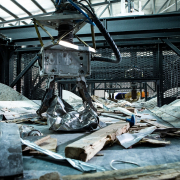
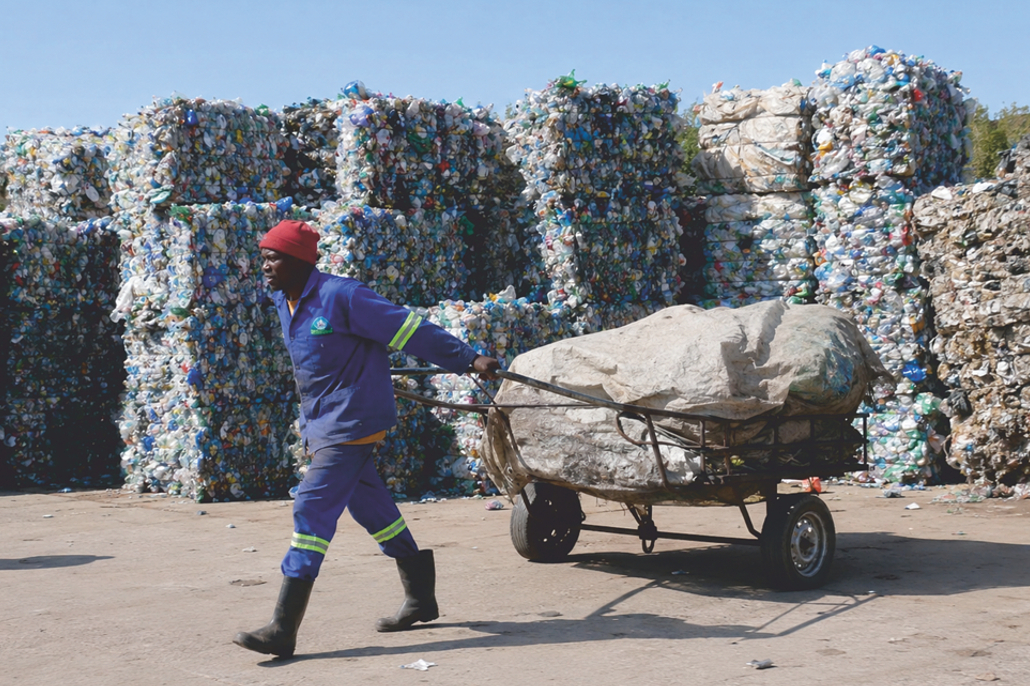
According to an assessment in 2022 regarding the circular economy in Zambia, most of the waste collected ends in a landfill – open dumpsites controlled by local authorities. As explained, this is because the country only has one engineered landfill located in Lusaka. Households and collectors do not separate the waste collected by local governments and private organizations. Informal waste pickers would segregate the valuable components of the waste. Organic waste makes up the majority of residential waste, accounting for 51 percent on average. Plastic is the second most common waste source (percentage portion: 14 percent), while metal (nine percent), paper (six percent) and glass (four percent) has a lower volume, the information said.
Opportunities in the circular economy
The authors of the Zambia Circular Economy Study 2024 identified business opportunities in five value chains, which could add 4.23 billion US-Dollar to Zambia’s economy.
- Municipal solid waste: Although the current recycling rates are low at around six percent, there is growing recognition of the potential to enhance recycling and waste valorization activities, the authors wrote. They estimated an improvement could be worth 340 million US-Dollar annually. This would include waste separation at source, optimized collection logistics, and establishing Materials Recovery Facilities (MRFs) to support recycling and waste-to-energy initiatives.
- Biofertilizer: In Zambia, only 25-30 percent of the required fertilizers is produced in the country. Locally produced biofertilizer could fill the market gap. The authors estimated that circular business opportunities could be worth about 1.76 billion US-Dollar.
- Biogas: Renewable energy in the form of biogas could be worth 53 million US-Dollar annually.
- Mining: As the ninth-largest copper producer globally, Zambia could generate 1.25 billion US-Dollar by expanding the value chain through circular economy practices like reprocessing and repurposing as well as e-waste recycling, to name a few examples.
- Textiles: Zambia generates an estimated volume of 149,000 tons of textile waste annually, the authors of the study stated. This available textile waste and second-hand clothing would offer an opportunity for textile-to-textile recycling, worth a potential 94.5 million US-Dollar per year. “Local organic cotton production and local spinning offer further business opportunities as global demand for organic cotton is constantly increasing.”
Investments
For investors, the Zambia Development Agency (ZDA) is the proper address. It is a statutory body under the Ministry of Commerce, Trade and Industry (MCTI). ZDA draws its mandate from the Investment, Trade and Business Development (ITBD) Act No. 18 of 2022 to foster economic growth and development by promoting trade, business development and investment in the Republic of Zambia through an efficient, effective and coordinated private sector led economic development strategy.
(Published in GLOBAL RECYCLING Magazine 2/2026, Page 22, Photo: MSV, AI-generated)