Ten Years to the Recycler
The length of time e-bike batteries remain in circulation before reaching a recycling plant has so far largely been a matter of estimation. A field study of 1,937 batteries at ACCUREC-Recycling GmbH in Krefeld now provides the first figures from day-to-day operations. It supports the EU’s assumption of around ten years and shows why raw data from a growing market suggest too short a lifetime.
Why lifetime determines the collection rate
From 2028, EU Member States must collect 51 percent of waste batteries from light means of transport; from 2031, the figure rises to 61 percent. This group consists chiefly of e-bike batteries. Percentages alone, however, say nothing about how many tons must actually be collected. What matters is the quantity they refer to.
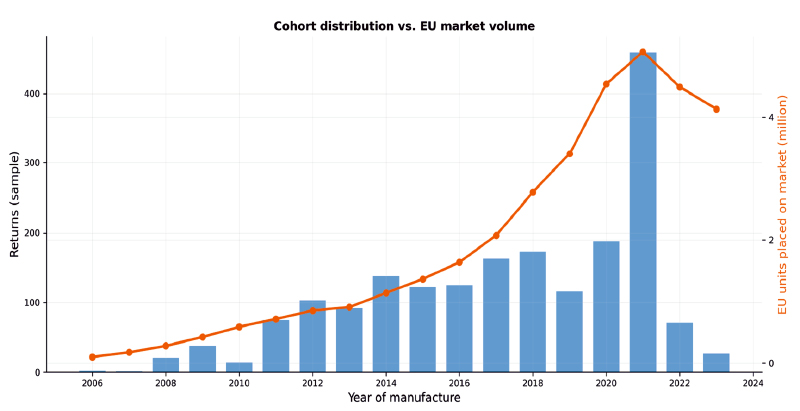
The bars show the manufacturing years of the 1,937 dated batteries; the line shows European e-bike sales in each year. The two curves run largely in parallel: the returns initially mirror the annual sales volumes, not the durability of the batteries
Until now, the reference quantity has been the mass sold in the three preceding years. For a product that is used for ten years or more, this is the wrong approach. Selling large volumes today immediately increases the quantity placed on the market, but the corresponding waste batteries will not arise until the 2030s. As a result, the collection rate appears lower than the system’s actual performance. The EU Batteries Regulation itself acknowledges this problem and obliges the Commission to revise the calculation method by 18 August 2027.
The European Commission’s Joint Research Centre (JRC) has proposed a different approach to the calculation. Instead of asking how much was sold in previous years, it asks how much is actually available for collection: Available for Collection, or AfC for short. It is calculated in three steps (see box). The first is the decisive one: based on past sales figures and an assumed lifetime, it estimates how many batteries reach the end of their use in a given year and are available for collection at all.
The result therefore hinges directly on a single assumption. If the assumed lifetime is too short, the calculation reports the quantities too early; if it is too long, too late. Precisely here, no data had been available. The values used stem from surveys of experts and industry associations. The JRC itself describes the situation as particularly difficult and intends to update its default values as soon as field studies become available. Moreover, the specifications are not internally consistent. In one place they state ten years; in another, a table from which only around 5.3 years can be derived arithmetically. The official assumption thus effectively lies somewhere between 5.3 and ten years.
Field study at ACCUREC: 1,937 batteries from four countries
Between August and November 2025, 44 large containers were fully sorted at the ACCUREC-Recycling GmbH site in Krefeld and 4,649 batteries were recorded individually, 4,631 of which belonged to the light means of transport group, predominantly e-bike batteries. They came from the collection schemes of the Netherlands, Belgium, Denmark and Finland.

Left: the raw distribution of return ages; right: the same data after weighting by the sales volume of the respective manufacturing year. The mean rises from 7.85 to 10.87 years
The type plate and casing of every battery were photographed. The images were processed by optical character recognition and automatically transferred into data fields. The manufacturing date could either be read directly from the type plate or reconstructed from the serial number, as many manufacturers encode the year and calendar week of production there. A comparison with manually verified reference data yielded accuracy rates of 99.2 percent for the manufacturer and 99.5 percent for the date. In the end, a reliable date could be determined for 1,937 batteries, or 42 percent of the total.
The missing 58 percent are unlikely to be distributed at random: older batteries and those with poorly legible labels are particularly affected. Therefore, the analysis had to rest on one assumption, namely that the age of these 58 percent does not differ systematically from that of the dated batteries. This cannot be verified with the available data. The assumption thus remains one of the key uncertainties of the result.
What was measured is not the technical lifetime of a cell but the return age: the time between manufacture and receipt at the recycling plant. It covers the entire use phase, but also storage in cellars and garages and the time spent in the collection system. For the EU’s calculation, this is precisely the right quantity, since there too storage time counts towards lifetime. The unweighted mean is 7.82 years, the median 7.30 years. The oldest battery in the field study was 19 years old.
The market is growing faster than the returns
This raw value describes the reality of what arrives at the plant. As an estimate for an entire sales generation, however, it is too low, for a simple reason: the market has grown strongly within a short time. According to figures from the European bicycle industry association CONEBI (Confederation of the European Bicycle Industry), e-bike sales in the EU have increased more than twentyfold within roughly a decade and a half, from a few hundred thousand units in the mid-2000s to a good five million in the record year 2021, followed by a slight decline (see Figure 1).
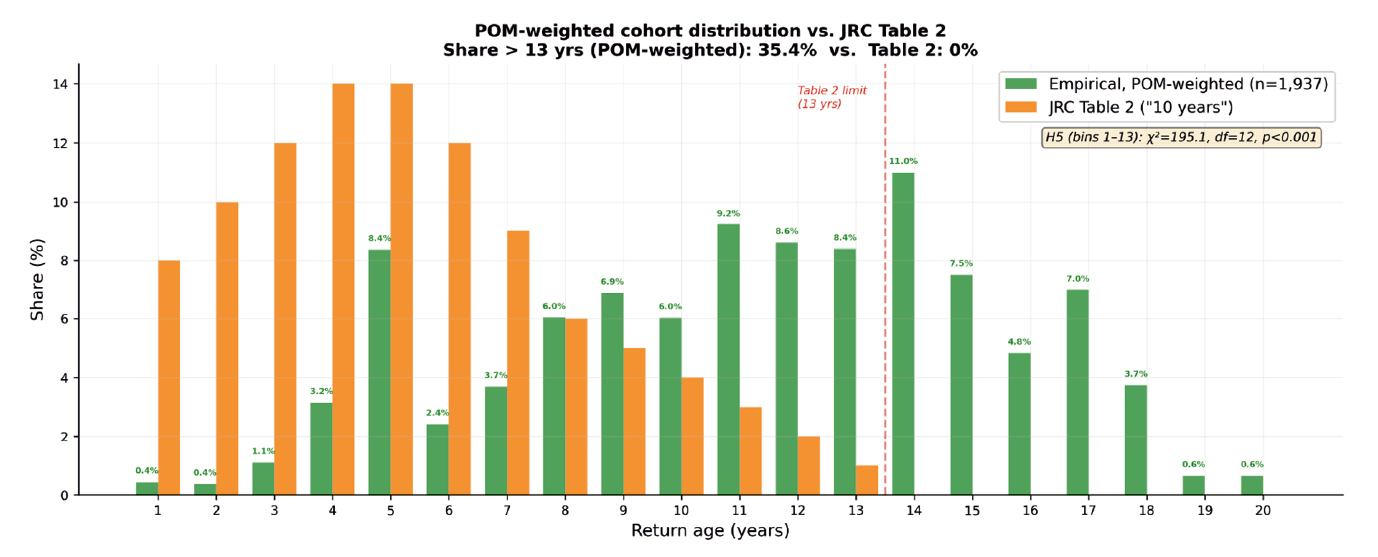
Weighted distribution of return ages (green) compared with the simplified table (orange). Around 35 per cent of the weighted returns lie beyond the 13-year cut-off; in the table, the share is zero
This is directly reflected in the sample. The manufacturing year 2021 alone accounts for 459 batteries, or 22.6 percent of all dated units. With five million bikes sold, even a small share of early failures produces high absolute return numbers. The large volumes placed on the market most recently therefore dominate the statistics and pull the mean downwards, even though only a fraction of them has returned at all.
This is more than a statistical subtlety. Because the strong sales years 2020 to 2022 are still young measured against a lifetime of around ten years, most of these batteries are still in use today or sitting unused at home. The real wave of returns is yet to come, and it will meet a market that continues to grow according to the JRC scenarios.
Lifetime: 7.8 years become 10.9
To correct this distortion, each observation was weighted by the sales volume of its manufacturing year. Batteries from early years with low sales count more heavily; batteries from later years with high sales count less. The basis is the three-year smoothed sales volume of the respective manufacturing year. A battery from 2009 is thus weighted around 25 times as heavily as one from 2023.
This shifts the picture considerably. The return age adjusted for sales volumes rises to 10.88 years, a difference of around three years. The empirical finding is thus close to the EU’s reference value of ten years. It supports this assumption without proving it, as the closeness depends on the chosen weighting scheme and on early manufacturing years represented by only a few units.
The methodological lesson is just as important. Return figures from a growing market should only be compared with regulatory assumptions after this correction. Without it, the ten-year value would wrongly appear far too high.
A contradiction in the simplified table
For Member States without data of their own, the JRC specification contains a simplified table. It specifies what share of a sales generation returns after one year, after two years, and so on, and it is headed by the reference value of ten years. Adding up its shares, however, yields a mean of only around 5.3 years. Moreover, the table ends after 13 years, although the associated formula sums over a period of 20 years.
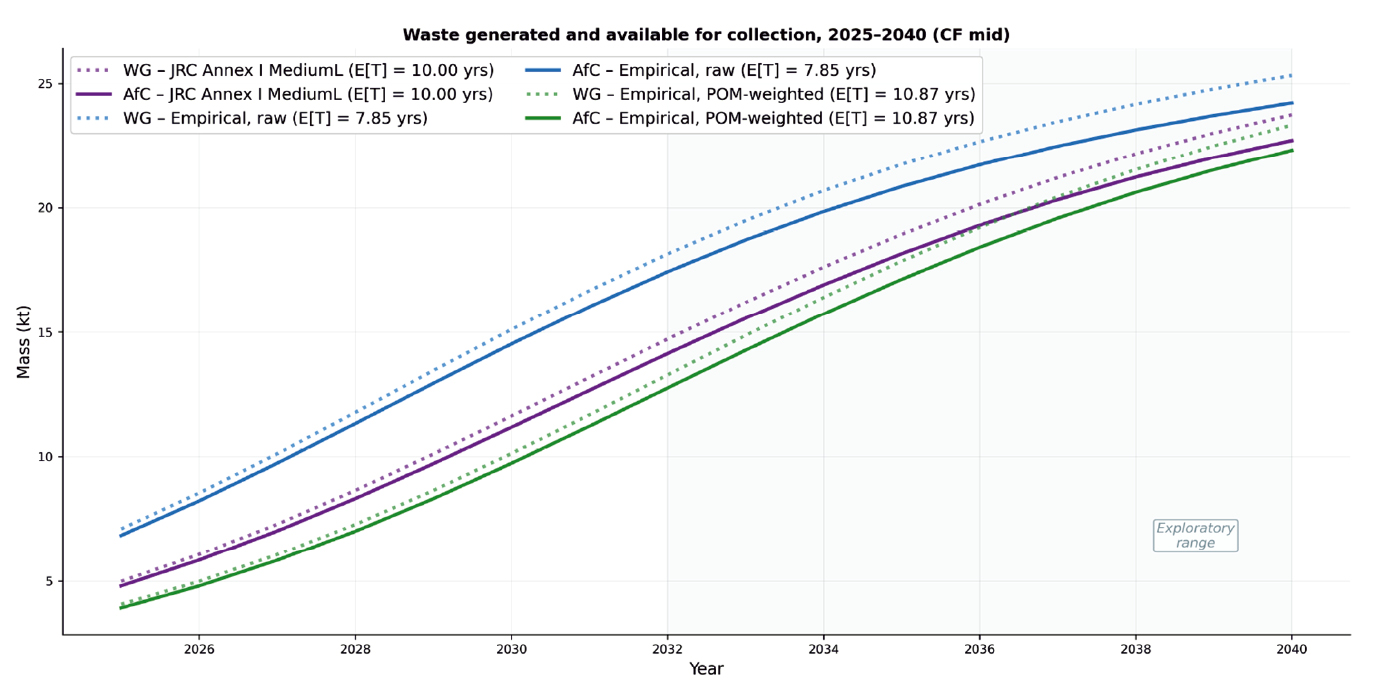
Calculated waste generated and collectable quantity in the EU up to 2040 under three lifetime assumptions. The curves converge in the long term. In the short term, around a third of the volume separates them
The field data collected at ACCUREC do not fit this. Around 12 percent of the unweighted and around 35 per cent of the weighted returns are older than 13 years and would go unaccounted for in a calculation based on this table. A statistical test confirms the deviation.
A look at the manufacturers’ regions of origin also shows how heterogeneous the products in this segment are: In the returns examined, batteries from European manufacturers show a mean age around three years higher than batteries from Asian manufacturers. This finding is expressly preliminary. It permits no conclusions about product quality or durability, since usage profiles, price segments, distribution channels and return routes are not taken into account. It does show, however, that a single lifetime value for the entire segment remains a rough simplification.
Looking ahead: What this means for the volumes
How much this assumption matters is shown by a comparative calculation using the JRC’s medium demand scenario. According to it, the mass of e-bike batteries placed on the market annually across the EU rises from around 12,200 tons in 2020 to around 28,800 tons in 2040. Depending on the scenario, the 2040 value lies between 16,400 and 46,700 tons. Inserting in turn the ten-year reference value, the raw value of 7.85 years and the adjusted value of 10.87 years into this calculation reveals a clear pattern: In the short term the effect is large; in the long term it disappears. For 2028, the raw value yields around 36 percent more waste than the reference value; for 2040, the three variants, at around 25,300, 23,700 and 23,300 tons, are only about seven percent apart. The assumption keeps the total quantity the same but changes when the waste shows up. For collection and recycling capacity, this timing is everything.
From this total volume of waste, the amount that does not enter the official collection system is deducted. For this purpose, new technical data currently being compiled for the drafting of the delegated acts were used: a combined deduction of around five per cent for repurposing and export. Across the EU, this would leave around 22,000 to 24,000 tons per year collectable by 2040, compared with around 4,100 to 7,100 tons in 2025. At a collection rate of 61 percent, this would correspond to around 13,500 to 14,700 tons per year that would have to be collected, a multiple of the quantities reported to date. These are not forecasts but comparative calculations. They depend on the demand scenario and on deductions that have not yet been finally determined.
What should follow from this
Two points can be incorporated directly into the forthcoming revision.
First, the correction for the quantity placed on the market each year should be made mandatory. Anyone deriving lifetimes from return or recycling data in a growing market must factor out the differing sales volumes and disclose the remaining uncertainties. This includes the fact that quantities placed on the market most recently are not yet fully visible in the returns, and that collection routes do not deliver a random sample. Unweighted and adjusted values must be reported side by side to ensure transparency about raw data and analytical method.
Second, the data base should be broadened before values are readjusted. Because lifetime moves short-term volumes so strongly, a robust value requires return data from several countries, sites and collection routes. The returns of a single recycling plant, including those examined here, are not sufficient. Precisely this kind of field evidence is what the JRC has envisaged for updating its values. Such studies, which should have high statistical relevance, need to be commissioned and funded.
Conclusion and outlook
The study provides a first empirical anchor for a value that had previously largely been estimated. The return age of 10.88 years, adjusted for sales volumes, supports the EU’s assumption of around ten years. The simplified table in the JRC study on AfC volumes, by contrast, should be reviewed, its mean aligned with the reference value and its time horizon extended. Alternatively, it should be explicitly labelled as illustrative. The limits of the study must be clearly stated. The data come from a single recycling plant with a north-west European catchment area, 58 percent of the batteries could not be dated, and the more recent manufacturing years are inevitably under-represented. Robust values require data from several countries and collection routes, ideally combined with a measurement of battery condition on arrival. Only then can use, storage and time spent in the collection system be separated from one another.
Only one year remains until the calculation method is revised. Using this time to underpin the lifetime empirically is considerably less costly than later measuring collection rates against quantities that never arose in this form.
(Published in GLOBAL RECYCLING Magazine 3/2026, Page 26, Photo: MSV, AI-generated, Graphics: Niklas Schiffgen)