
GREENS 2026 Founding Edition Brings India’s Recycling and Circular Economy Ecosystem Together, and GREENS 2027 Is Announced for 10 to 12 June
The Global Recycling Expo & Summit drew 75 speakers, 80 exhibitors, 1,000 summit delegates and 8,000 trade visitors to Gandhinagar, and returns next year with a larger expo, a wider summit programme and international pavilions.
GREENS, the Global Recycling Expo & Summit, concluded its founding edition on 6 June 2026 at the Helipad Exhibition Centre in Gandhinagar, Gujarat, after three days that combined an 11-track policy and industry summit with a trade exhibition built around the recycling and circular economy value chain. Organised by SALT Alliances and the Gujarat Chamber of Commerce and Industry (GCCI), the event was designed as a working platform where those who make policy, those who must implement it, and those who build the technology and capital behind it could meet in one place. The organisers have now confirmed the second edition for 10 to 12 June 2027 at the same venue.
Why GREENS was created
India’s circular economy has never lacked ambition, regulation, innovation or entrepreneurial energy. What it has lacked is a shared platform, a place where policymakers could meet the producers and recyclers who are expected to implement their rules, where technology providers could understand problems on the ground, and where government, finance, industry and research could stop discussing circularity in parallel and begin working on it together. GREENS was created to close that distance, and the founding edition set out to examine what it takes to deliver the transition, from infrastructure, traceability, technology and viable markets to capital, compliance and collaboration.
Ketan Prajapati, Director, SALT Alliances: “The objective was not merely to bring the industry together. It was to make that gathering useful: to surface implementation gaps, connect demand with solutions, place regulatory questions before industry, and document what must happen next. The Founding Edition proved that there is both a need and an appetite for such a platform.”
Why Gujarat
The organisers chose Gujarat because a circular economy has to be built where industry already operates at scale. The state has more than 200 industrial estates covering over 33,000 hectares, one major port and 48 non-major ports, and 38% of the Delhi-Mumbai Industrial Corridor passes through it, which gives the event a combination of manufacturing depth, sectoral diversity, infrastructure and proximity to policymakers, regulators and industry institutions that few other locations can offer. The summit was also an official side event of the World Circular Economy Forum 2026, which placed GREENS within the international circular economy calendar in its first year.
The founding edition in numbers
Over three days from 4 to 6 June 2026, GREENS hosted 75 speakers across 11 summit tracks, 80 exhibitors, 1,000 summit delegates and 8,000 trade visitors, drawn from 23 Indian states and 12 countries. The audience was selected for relevance and not for volume, since 69.3% of attendees came from manufacturing, core recycling and environmental sectors, 79% reported direct commercial intent, and 67% held ownership, leadership or management roles. Deloitte India served as Knowledge Partner, the Gujarat Pollution Control Board as Knowledge Support partner and iNDEXTb as Industry Partner. The pre-event campaign reached audiences through social platforms, email, WhatsApp networks, industry associations, outdoor media, cinema screens, partner channels and personal referrals, and recorded 5.99 million views and impressions.
The summit: eleven tracks, one agenda
The summit was built around one question, which was how circularity can create value once the conversation ends. India entered 2026 with the most consequential set of waste and circular economy regulations in its history in force, including the SWM Rules 2026, an expanded EPR regime across plastics, metals and construction waste, the FSSAI recycled-content mandate, and a Carbon Credit Trading Scheme moving from voluntary to compliance. The discussion in the room was that the technology exists and the architecture is taking shape, but the system has not yet caught up with its own rulebook, and three gaps recurred across sectors: price signals that leave formal recovery at a disadvantage against virgin material, an informal collection system that sits outside the architecture meant to govern it, and policy that has moved faster than the infrastructure, financing, enforcement and data needed to deliver it.
The tracks covered the full range of waste and recovery streams. The solid waste session examined the infrastructure deficit that the SWM Rules 2026 expose. The plastics session heard that around 70% of material still moves through the informal chain and that brands hesitate over recycled quality more than over availability, which pointed to AI-based sorting and lab-grade quality control as the practical answer. The metal session looked at how fake GST credits let unorganised traders outbid formal recyclers, why the 18% GST on scrap is seen as the root cause, and how Europe’s 2027 waste-shipment cutoff threatens 30 to 38% of India’s non-ferrous feed. The water treatment session argued that zero liquid discharge should be run as a resource-recovery business yielding water, salt and carbon credits, and the tyre recycling session considered EPR, new technologies and where the industry should stand in ten years.
The construction and demolition session heard that recycled aggregate cannot compete while illegal riverbed sand is effectively free, with Ahmedabad’s 2,000-tonne-a-day facility offered as proof of what works. The critical minerals session addressed an import clearance process that takes more than a year across five departments and a sector in which 78% of material still flows informally, and concluded that the informal workforce is an asset to formalise and not a problem to eliminate. The solar session made the case for a separate EPR regime that does not leave panels orphaned, and the session on EPR in the age of AI described five category portals converging into a single sign-on with blockchain-backed certificates to counter fraud, while warning that the real gap lies in plant-floor data that is still kept in registers. The carbon markets session observed that there are almost no methodologies for recycling streams and that baselines rely on global defaults and not on Indian data, and the closing session on business potential found a sector that has moved from philanthropy to profitability, held back by thin domestic risk capital and by imported machines built for waste that is not India’s.
Five signals emerged from the room for policymakers and industry: reform the economics of recycling, treat recycling as material security, make compliance verifiable, build the investment case, and move from rules to execution. These outputs are feeding into a national white paper that GREENS is preparing for submission to the Government of India.
The expo: where the discussion became business
The exhibition translated the summit’s challenges into technologies, services and commercial conversations. Its 80 exhibitors, spanning recycling machinery, water treatment, waste management, AI and robotics, met 8,000 trade visitors drawn largely from manufacturing, recycling and environmental businesses, and the floor was complemented by a set of Waste-to-Art sculptures made from scrap, which showed what recovered material can become.
Exhibitors rated the experience highly. In the post-event survey, 96% reported a positive experience, 92% said their objectives for the show were achieved, 81% met serious prospects and 81% rated GREENS good value for money, and every exhibitor surveyed said they would return in 2027.
An event that practised circularity
GREENS also applied circularity to its own operations, incorporating it into vendor and exhibitor engagement, branding, stationery, material selection, waste segregation, recovery systems and carbon measurement. Independent sustainability reporting recorded 2,993.95 kg of waste across build-up, show days and breakdown, of which 2,871.55 kg was recycled, composted or upcycled and 122.40 kg of PVC flex went to controlled energy recovery, leaving landfill at 0 kg and the recyclability rate at 95.91%. The event was recorded as carbon neutral, with estimated emissions savings of 4,729.01 kg of CO2 and 23.2 trees saved, and more than 80 stalls took part in source-level segregation.
 GREENS 2027: the next edition builds the scale
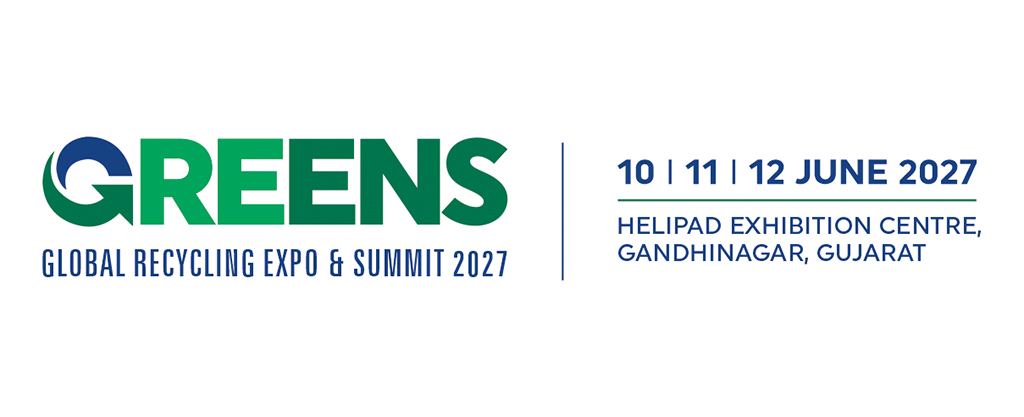
The second edition will take place from 10 to 12 June 2027 at the Helipad Exhibition Centre, Gandhinagar, and is planned as a considerably larger platform, with projections of 300 exhibitors, 15,000 visitors and 2,000 summit delegates. It will add international pavilions, an expanded knowledge programme and stronger buyer and seller engagement, together with a more ambitious circularity and carbon-reduction plan. The summit programme will extend beyond the founding edition’s sectors to new industrial streams, including chemicals, pharma, textiles, ceramics, cement, bio-medical waste, effluent treatment and municipal solid waste.
About GREENS
GREENS, the Global Recycling Expo & Summit, is a platform for India’s recycling, circular economy, waste management and sustainability ecosystem, bringing policymakers, producers, recyclers, technology providers, investors and researchers into one room to work on implementation. It is organised by SALT Alliances and the Gujarat Chamber of Commerce and Industry (GCCI).
Media and participation enquiries
For media enquiries, exhibition, sponsorship and speaking opportunities for GREENS 2027, please write to info@greensexpo.com, call +91 7575 8080 97, or visit greensexpo.com.
Source: GREENS (GANDHINAGAR, 23 November 2026)