GLOBAL RECYCLING
  • Home
  • Magazine
  • Articles
    • Business Chances
    • Enterprises
    • Newsflash
    • Markets
    • Machinery
    • Processing Methods
  • Advertiser
  • Events
  • Media Kit
  • Imprint
  • Click to open the search input field Click to open the search input field Search
  • Menu Menu
  • Link to X
  • Link to Facebook
  • Link to Instagram
  • Link to LinkedIn
  • Link to Rss this site

Over 50% Virgin Plastics Substituted in Shrink Film – APK’s Newcycling® LDPE Recyclate Delivers on Shrinkage and Film Thickness

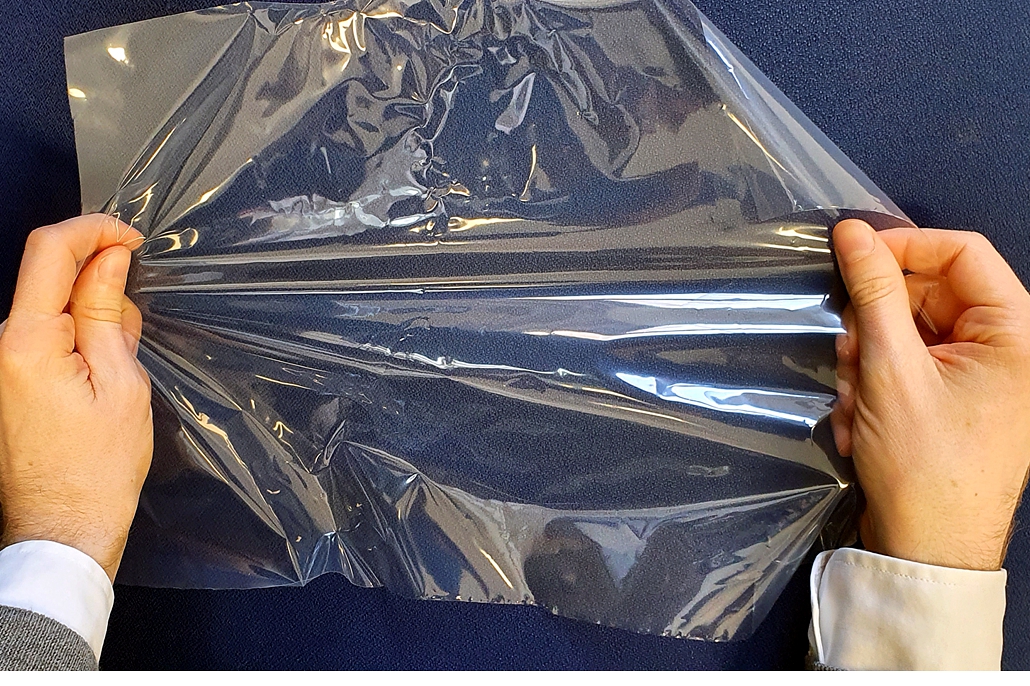
Broadening the market potential of plastic recyclates and thereby furthering the uptake of recycled content across Europe is APK AG’s core objective. The innovative recycling company from Merseburg, Germany has tested the performance of its Newcycling® LDPE recyclates in shrink films during several projects undertaken over the course of this past year. Primary test results showed that the recyclates were able to deliver on the key functional issue of shrinkage. Film thickness was able to be maintained at the same level as with virgin plastics. Formulation of the shrink films and extrusion parameters remained close to the virgin feedstock version.

Collation shrink film is a demanding packaging application – for virgin polymers and all the more so for recycled materials. It needs to have a specific toughness, holding force, and shrink performance for it to guarantee package integrity as well as the necessary stability for storage and transport. Process parameters should remain constant when switching from virgin to recycled feedstock. Beyond this, as the film may be used as secondary packaging for bundling several products, making it the first thing the consumer sees, optics need to be of a high-enough quality.
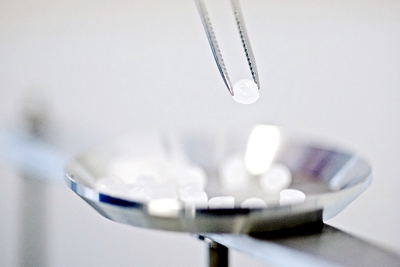
Mersalen® LDPE NCY recyclates produced with APK’s Newcycling® process. (Photo: APK AG)

‘Our LDPE recyclates are suitable for a broad number of end markets. When it comes to shrink films, they represent an opportunity for the beverage industry to push its use of secondary raw materials in applications such as shrink sleeves or multipack sleeves’, explains Klaus Wohnig, CEO of APK, in discussing one of the possible target markets for the product.

During the projects that focused on multi-layer collation shrink films, ambitious substitution rates for virgin feedstock, ranging from 30% to 100%, were tested. The 30%-55% scenarios produced impressive results: the shrink film was nearly indistinguishable from that made of virgin material. Substituting virgin plastics for these amounts of secondary raw materials would already allow for a decisive reduction in emissions. Newcycling® LDPE recyclates produce nearly 50% fewer emissions than virgin LDPE types.

APK’s dissolution recycling process, the Newcycling® technology, can easily separate different polymers in multilayer plastic packaging – up to now, deemed non-recyclable – and transforms the target polymer into re-granulates with close to virgin properties. Dissolution recycling is an advanced physical recycling technology. Building on a mechanical pre-treatment step, it adds a solvent-based process step, during which the target polymer is separated and purification of contaminants, such as various additives or organic residues, also takes place. APK’s recycled LDPE, used during the shrink film tests, is marketed under the Mersalen® brand. It is derived from complex PE/PA multilayer film waste.

As Newcycling® is a physical process and does not affect the molecular chains of the polymer, cost- and energy-intensive re-polymerisation is not needed. The technology is to be considered besides and complementary to standard mechanical recycling as well as innovative chemical processes (such as solvolysis) for this matter.

About APK
APK was founded in 2008 with the vision of producing pure polymers from plastic waste, with properties close to virgin plastics. APK’s researchers and engineers have developed a suite of environmentally sound and market-leading recycling technologies under the Newcycling® brand. At its industrial-scale plant in Merseburg (Saxony-Anhalt, Germany), APK currently employs around 130 engineers, researchers, and administrative staff and features a recycling capacity of up to 20,000 tonnes per year. The two well-established plastic recyclate products produced in Merseburg are marketed as Mersalen®and Mersamid®. More information is available at www.apk-ag.de/en.

Follow APK AG on Twitter: @APK_AG


Source: APK AG (Merseburg, 24th of November, 2020)

 

8,232
Share this entry
  • Share on Facebook
  • Share on X
  • Share on WhatsApp
  • Share on Pinterest
  • Share on LinkedIn
  • Share on Tumblr
  • Share on Vk
  • Share on Reddit
  • Share by Mail
https://global-recycling.info/wp-content/uploads/2020/11/APK-PR-1.jpg 686 1030 msv2016 https://global-recycling.info/wp-content/uploads/2023/12/GR-Logo-250-100.png msv20162020-11-26 09:37:162020-11-26 09:37:16Over 50% Virgin Plastics Substituted in Shrink Film – APK’s Newcycling® LDPE Recyclate Delivers on Shrinkage and Film Thickness
You might also like
European Recyclers Urge Tougher Scrutiny of EPR Schemes
USA: New Solution for Plastics Recycling
Mondelēz International Launches Green Bond Offering
Global Recycling Foundation calls on the world to combat climate change by championing recycling
USA: Project to Modernize Recycling Collection in Baltimore
Smart Investments Lead to Success

AD

Translation

GLOBAL RECYCLING

The Magazine for Business Opportunities & International Markets.

Global trends in the circular economy, particularly in the recycling and recovery industry as well as in waste recycling. Markets for technology, logistics and raw materials.
© MSV Mediaservice & Verlag GmbH
Privacy Policy

Check out our websites

EU-Recycling
Recyclingportal

Topics

Business Chances, Enterprises, Newsflash, Markets, Machinery, Processing Methods and Events.
In general: Recycling Industry, Circular Economy, Recycling Technology, Secondary Raw Material, Recycling, Recycling Markets, Collection, Reuse, Waste, Waste Management, Industrial Waste, Automobile Recycling, Scrap, C&D Waste, Electronic Scrap Recycling, Screening Machines, Separator, e-Waste, Sorter, Sensor Sorter, Splitter, Crusher, Shredder, Magnetic Separators, Metal Recycling, Ferrous, Non-Ferrous, Plastic Recycling, Scrap Recycling, Wastepaper, Plastic Waste, Second Hand Clothing, Textile Waste, Tyres, Hazardous Waste, Waste Processing Plants, Waste Legislation and much more.

Tags

AI aluminum batteries BIR China circular Circular Economy collection E-Waste economy energy EuRIC Europe FEAD Global Recycling Foundation India Industry landfill management metal metals packaging Paper PET plant plastic plastics Plastic Waste recovery Recycling Scrap Shredder shredding sorting steel sustainability Sustainable technology Textile Textiles USA waste waste management wastewater WEEE
Link to: SABIC Expands Post-Consumer Recycled Engineering Thermoplastics for Consumer Electronics and E&E Applications Link to: SABIC Expands Post-Consumer Recycled Engineering Thermoplastics for Consumer Electronics and E&E Applications SABIC Expands Post-Consumer Recycled Engineering Thermoplastics for Consumer... Link to: Perstorp Plan to Reduce Carbon Emission with Half Million Tons by Producing Sustainable Methanol Link to: Perstorp Plan to Reduce Carbon Emission with Half Million Tons by Producing Sustainable Methanol Perstorp Plan to Reduce Carbon Emission with Half Million Tons by Producing...
Scroll to top Scroll to top Scroll to top