
New Pathways for China’s Textile Industry
As global demand for clothing continues to rise, the textile and apparel industry has become a significant contributor to climate change.
In China, the world’s largest textile producer and exporter, rapid urbanization, income growth, and shifting consumption patterns have driven a surge in demand for apparel. According to TranSpread – which aims to help academic journals overcome challenges such as limited overseas promotion channels, increase their exposure abroad, and enhance their international influence – traditional studies often focus on factory-level energy use, overlooking emissions embedded in supply chains, exports, and household consumption. “This fragmented perspective limits the effectiveness of mitigation strategies. Moreover, fast fashion and short garment lifespans exacerbate resource use and waste. Based on these challenges, there is an urgent need to conduct in-depth research that captures the full carbon footprint of the textile industry and identifies scalable pathways for emission reduction.”
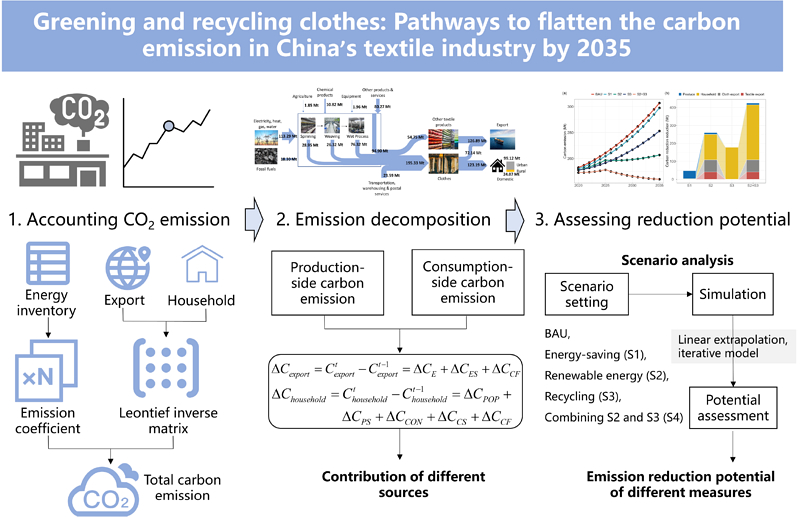
An integrated framework for accounting, decomposing, and mitigating carbon emissions in China’s textile industry (Source: TranSpread)
Therefore, researchers from Nanjing University, in collaboration with international partners, reported a comprehensive analysis of carbon emissions in China’s textile and apparel industry in the magazine Engineering Environment. “Using national household consumption data and supply-chain input–output modeling, the team examined emission trends from 2000 to 2018 and projected future mitigation scenarios through 2035,” TranSpread informed. “Their study reveals how production, consumption, and exports jointly shape the sector’s carbon footprint and highlights practical strategies – particularly renewable energy and clothing recycling – to curb emissions while supporting sustainable industrial development.”
The study titled “Greening and recycling clothes: pathways to flatten the carbon emission in China’s textile industry by 2035” is available at:
link.springer.com/article/10.1007/s11783-026-2109-9
(Published in GLOBAL RECYCLING Magazine 1/2026, Page 35)