
Which EPR Design is More Efficient?
The EU’s Circular Economy Action Plan promotes emissions reduction, waste minimization, and resource efficiency by, inter alia, incorporating the Extended Producer Responsibility (EPR), which has been mandatory in EU Member States since 2018 under regulations such as the Packaging and Packaging Waste Regulation (2025).
Given that around 80 million tons of packaging waste are generated annually in the European Union, the question arises whether there is a way to achieve higher recycling rates at a lower cost. According to the study “Efficiency and Performance of Packaging EPR Systems in the EU – A Comparative Analysis of Different Countries and Market Structures”, conducted by Paolo Facco and Richard Berner from German-based company adelphi consult GmbH, efficiency depends on several factors. In their analysis, the authors compared EPR systems in Germany, France, Italy, Belgium, Spain, the Netherlands, Austria, and the Czech Republic.
The key findings
- “Design drives results. Systems in which Producer Responsibility Organizations (PROs) run operations end-to-end and own material consistently achieve higher yields and better unit costs.
- Evidence across streams. Germany achieves a weighted household plastics recycling rate of 76.1 percent when deposit-return PET is included (Belgium is second with 60.8 percent); Belgium reaches 97.8 percent for glass (Germany 88.5 percent). Strong governance delivers strong results across different market conditions.
- Competitive systems sharpen efficiency and innovation. Evidence from across the EU shows competition sharpens performance where PROs also hold responsibility, material, and costs.”
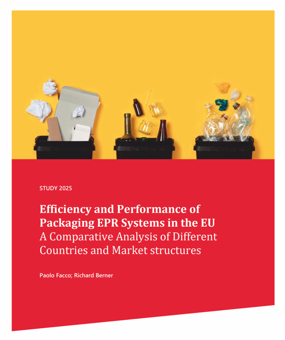
Source: STUDY 2025, adelphi
“When PROs control the entire value chain from collection to recyclate marketing, they can optimize for material quality, volume efficiency, and cost effectiveness. This end-to-end responsibility creates results that go beyond market structure considerations,” the authors emphasized in the study. “However, competition provides additional performance benefits when combined with operational responsibility.” The German experience (editor’s note: with ten PROs) would demonstrate how competitive pressure drives continuous innovation, cost efficiency, and service quality improvements beyond what might be achieved through operational responsibility alone. “The combination of competition and operational control creates a dynamic system where market forces drive performance while operational accountability ensures effective implementation”.
adelphi.de/system/files/document/epr_study_0411.pdf
(Published in GLOBAL RECYCLING Magazine 1/2026, Page 10)