Project to Transform Recycled Nylon Fishing Nets
The companies UBE and ZIKNES, the University of Valencia, and the AIMPLAS Plastics Technology Centre are collaborating on the project REDES4VALUE. The objective is to close the life cycle of polyamides and reduce marine pollution through innovative, industry-ready solutions. Collaboration with the Sea2See brand has ensured access to fishing nets recovered in Ghana since 2019 and has been key to structuring the project’s circular value chain from the waste source.
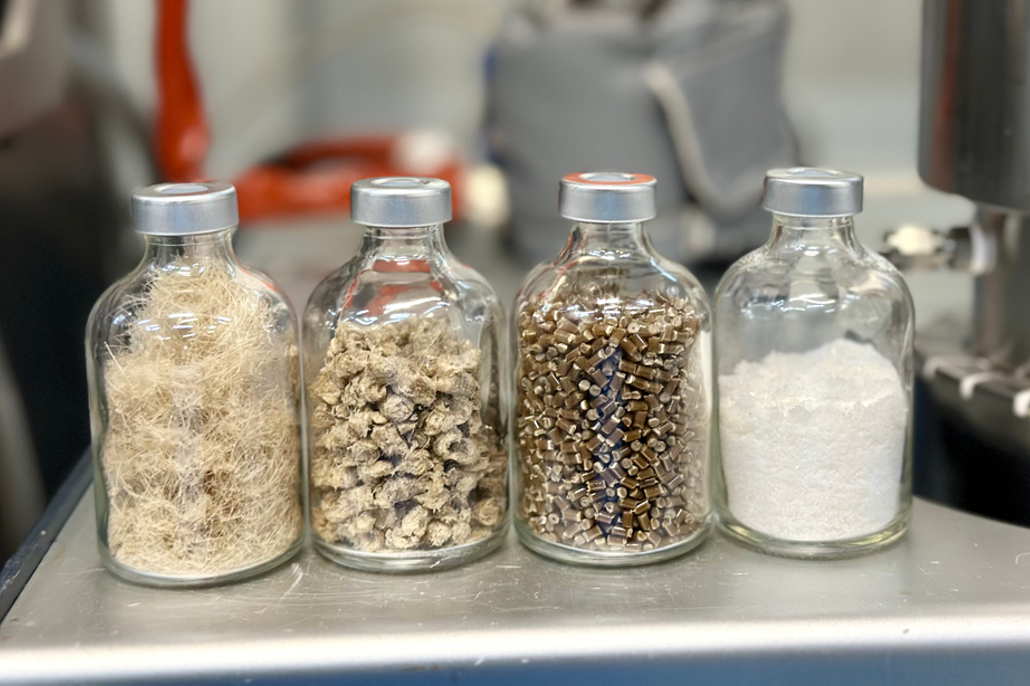
According to the consortium, the abandonment of fishing nets in seas and oceans is one of the most persistent environmental problems. In response to this situation, the REDES4VALUE project would work to recover and recycle disused fishing nets, transforming them into new sustainable, high value-added products such as recycled nylon, films for packaging and agricultural covers, automotive components, and large-format parts produced by additive manufacturing. “These developments are achieved through innovative mechanical and chemical recycling processes, combined with reactive extrusion technologies,” AIMPLAS underlined.
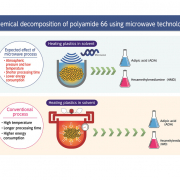
Although many nets are made of polyethylene or polypropylene, this project would focus on polyamide nets, a material with great potential for chemical recycling. Its molecular structure allows the recovery of monomers such as caprolactam, enabling the production of new polyamides with properties virtually identical to those of virgin materials. “We are achieving optimized conditions for depolymerizing fishing nets and recovering monomers with purities above 95 percent in some laboratory-scale streams, and over 80 percent at pilot scale. This will allow us to repolymerize and obtain new polyamides with quality equivalent to virgin material,” Nairim Torrealba, a researcher in chemical recycling at AIMPLAS, was quoted.
As reported, recycled polyamides are intended for sectors such as packaging, agriculture, automotive and 3D printing. Companies such as UBE are already analyzing their commercialization and ZIKNES is adapting its equipment to validate large-format parts. Initial applications would include packaging films, agricultural covers, automotive components and large-scale 3D demonstrators.
But there are some tough areas. One of the main challenges of the project is treating highly degraded nets with a high presence of impurities. According to AIMPLAS, the results are still very promising. The project would be advancing in processes such as hydrothermal depolymerization, ionic liquid-assisted solvolysis and reactive extrusion, as well as comprehensive life cycle and feasibility assessments.
As per Torrealba, the goal is to consolidate a chemical recycling line that can be applied to complex waste and “demonstrate that it is a real and necessary solution”.
aimplas.net/technologies/recycling/
(Published in GLOBAL RECYCLING Magazine 2/2026, Page 31, Photo: AIMPLAS)