Extending the Scope of Shredders for Plastics Recycling with a Flexible Cutting System
Modern plastics come in all shapes and sizes, and are used in countless applications. The different materials must be, for example, particularly tear-resistant in terms of ropes or nets, withstand great pressures in the case of pallets and similar, or keep their shape as for cladding parts. The underlying parameters are mechanical properties such as elongation at break, impact toughness or Shore hardness. However, these factors not only determine the polymer’s area of application or the service life of the end product, but also require different approaches to shred and process these materials for recycling purposes in line with the concepts of the circular economy. Since 2001, Candi Plastic Recycling in Sollenau, Lower Austria, has been transforming industrial waste thermoplastics into premium homogeneous recyclates. As a contract manufacturer, the company relies on Lindner’s shredders with flexible cutting units to ideally cater to customer needs.
Because of the different mechanical properties of plastics, shredder cutting systems are often specifically designed to shred a particular material. For example, the cutting geometry of pointed knives has a positive effect when shredding extremely tough materials such as big bags, ropes or nets that have to withstand high tensile loads. Here, the force provided by the drive unit focuses perfectly on a very small area, with the cutting system shredding highly tear-resistant materials as if it were a knife or scissors. On the contrary, flat knives have really proven their worth in terms of processing rigid plastics like polypropylene. Materials such as plates, crates, or plastics manufacturing residues (from extrusion, injection moulding, etc.) which are relatively thick-walled compared to fibres, can be broken down more easily over a parallel cutting edge. The knives operate over a large area and aggressively draw in material, and this, in turn, has a positive effect on throughput.
The choice of the right cutting system, or rather the interaction of rotor and stator knives and speed, also decisively influence particle quality. Here, it is particularly important to avoid fines in the material flow because they negatively affect downstream processes and can lead to blockages in cleaning components or the fine screens of extruders, for instance.
The above examples show how extensive this topic really is. The economic component in particular plays an important role here. It often happens that contract manufacturers have to accept other materials, such as lumps from production processes, along with the main material, which may be a film. Furthermore, several different types of waste plastics often have to be processed to fully utilise production capabilities. If a separate shredder is now used for each material stream – depending on the company’s size and volumes being shredded – it is difficult to demonstrate economic viability. For this reason, smaller batches are often sold on, which in turn reduces the overall productivity.
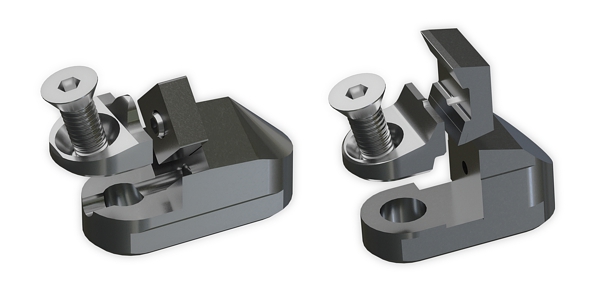
Mono-Fix technology (Photo: Lindner)
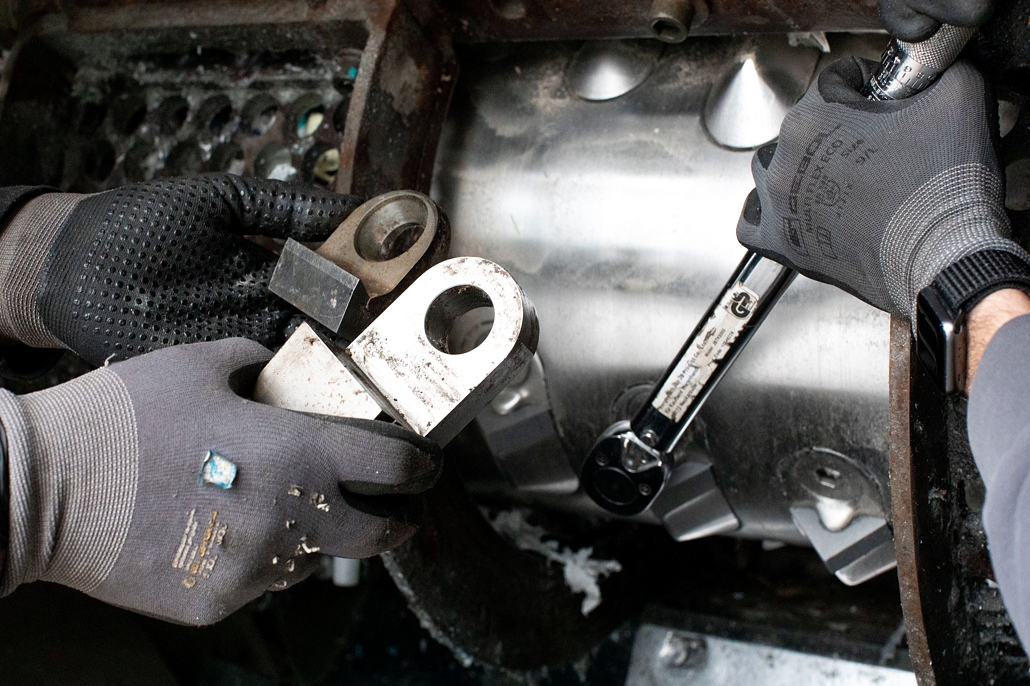
Lindner addressed this problem and turned the established Mono-Fix technology into a smart system. Thanks to the Mono-Fix – originally developed to minimise downtimes during maintenance – knives and knife holders can be changed using just one screw. More modules have now been added to the existing system. Different pointed and flat knives are available, as well as cover plates and special counter knives that can be fixed to the same rotor body. This extended range now makes it possible not only to replace the cutting system completely in the event of wear and tear, but also to use different or mixed rotor configurations. Mixed cutting systems can avoid common problems caused especially by difficult materials such as massive lumps and purgings because pointed knives would otherwise mill into the plastic, causing throughput to drop sharply. Combining the two systems produces particles that are precisely cut by the pointed knives, and the flat knives cut loose any milled-in material. Using special filler plates, the aggressiveness of the cutting unit can also be adjusted so that it is possible to shred heavy materials at corresponding throughputs even at low drive power. In addition to the flexible rotor configurations, customised software set-ups make it possible to tailor relevant machine control and frequency converter parameters to the respective application.
The flexible cutting system was created in cooperation with the Austrian plastics recycler Candi Plastic Recycling GmbH, which is already successfully using it. At the headquarters of the family-owned business, about 3,000 metric tons of thermoplastics such as PE, PP, PS and ABS are turned into homogenous regranulate every year. The materials, which are processed south of the Austrian metropolis of Vienna, as well as at their subsidiary Calex in Baia Mare, Romania, mostly come directly from international big players in packaging and brand product manufacturing.
One of the secrets of the company’s twenty years of success is its ability to constantly adapt to different materials and new customer requirements. Andreas Campan, Head of Production and Chief Technician at Candi Plastic Recycling, explains: “We process thermoplastics in almost every shape, from films to hollow bodies to lumps. Since more and more producers want to avoid waste as much as possible, the required purchase quantities are constantly increasing and with them the variety of different materials. To meet our customers’ demands, and also to ensure our facilities are as productive as possible, we rely on technologies that enable us to cover the broadest possible material spectrum.” Specifically in terms of shredding, the company relies on Lindner’s compact shredders for the first stage in the recovery process. The decision to buy from this manufacturer was once made on the basis of industry recommendations.

Andreas and Gheorghe Campan, Candi Plastic Recycling (Photo: Lindner)
Today, Candi Plastic Recycling and Lindner are very much partners working together on smart solutions to tackle new challenges. “We were looking for a solution that would allow us to process as many different materials as possible with one single machine. This keeps the investment costs in check and ensures that we can exploit our full production potential. If these requirements are met, we can ultimately increase our sales. When we approached Lindner, they were immediately willing to help tackle this issue,” Campan explains. The result of this cooperation is a flexible cutting system based on Lindner’s tried-and-tested Mono-Fix technology. Thereby it is possible to quickly adapt the shredder to a wide range of materials. The different knife geometries and rotor configurations ensure consistently high outputs. Stefan Scheiflinger-Ehrenwerth, Head of Product Management at Lindner Recyclingtech, states: “We always place great value on developing solutions together with our clients and paying close attention to our clients’ specific needs. This approach has paid off once again in our collaboration with the great team at Candi.”
The turnkey packages can be ordered as material-specific options perfectly suited to the relevant application and shredder. In developing this solution, Lindner primarily relied on the application know-how acquired internationally over decades, because after all, the ideal shredder configuration for PP/PA ropes in Chile also works wonderfully on the coasts of Norway.
Source: Lindner (Spittal/Drau (Austria), May 31, 2021)